Cookies help us deliver the best experience on our website. By clicking Accept you are agreeing to the placement and use of cookies as described in our privacy policy.


Most “low maintenance indoor plant” guides recommend the same decorative list: pothos, snake plant, ZZ plant, peace lily. These are genuinely easy to keep alive. But they don’t feed you. This guide covers a different question: which indoor plants are low maintenance and produce something you can actually eat, and what system makes food-growing as effortless as a houseplant.
Key takeaways
- The easiest food-producing plants to grow indoors are herbs and leafy greens, most require less attention than a typical houseplant once growing conditions are dialed in.
- The variable that kills most indoor food plants is inconsistent watering and inadequate light : both of which automated hydroponic systems handle without human input.
- Gardyn’s Hybriponic™ system automates watering, lighting, and plant monitoring, reducing weekly active maintenance to approximately 5–10 minutes.
- The easiest-starting herbs (basil, chives, mint, arugula) reach first harvest in 3–4 weeks and produce continuously for months.
- Kelby AI monitors plant health around the clock and alerts you only when something needs attention, so you’re not guessing.
Why “low maintenance” means different things for food vs decorative plants
Decorative houseplants are low maintenance because most tolerate, and some prefer, benign neglect. A snake plant survives weeks without water. A ZZ plant thrives in low light. The success condition is simply “still alive,” and the bar is low.
Food plants have a higher success bar: not just alive, but actively growing and producing. An herb that survives on a dim windowsill with irregular watering will be alive but won’t produce much worth harvesting. The low-maintenance version of food growing requires that the conditions plants actually need, consistent water, adequate light, stable environment, are delivered reliably without depending on you to deliver them.
That’s the core argument for automated indoor gardening: not that it makes food plants easier to keep alive, but that it maintains the specific conditions that make them productive, without the daily judgment calls that traditional growing demands.
What makes indoor food plants fail (and how automation solves each one)
| Failure mode | Traditional growing | Automated hydroponic system |
| Inconsistent watering | Manual, depends on memory and schedule | Automated pump cycle, reservoir topped weekly |
| Inadequate light | Depends on window orientation and season | Integrated full-spectrum LED on programmed schedule |
| Overwatering / root rot | Common beginner error | Hydroponic system : no soil to waterlog |
| Forgetting while traveling | Plants decline or die | Vacation mode; 2-week absences manageable on full reservoir |
| Not knowing when something is wrong | Visible damage often late-stage | Kelby AI monitors continuously, alerts early |
| Running out of nutrients | Manual fertilizer schedule | Nutrients added with water; simple and periodic |
The pattern is consistent: every major failure mode in indoor food growing is either eliminated or caught early by an automated system. The residual maintenance, refilling the reservoir weekly, replacing yCubes when a plant finishes its cycle, is genuinely minimal.
The easiest herbs and greens to grow indoors
Within an automated system, plant selection still matters for beginners. Some varieties are faster, more forgiving, and more productive from the start. These are the lowest-friction starting points:
Fastest first harvest (3–4 weeks)
- Basil, The benchmark beginner herb. Vigorous germinator, visible daily growth, productive from week 3. Harvest frequently to prevent bolting.
- Arugula, Fastest of the salad greens; harvestable in as little as 21 days. Cut-and-come-again growth for 6–8 weeks.
- Chives, Grass-like growth that is almost impossible to kill under automation. Continuous snip harvest; regrows within days.
- Butterhead lettuce, Gentle flavor, generous yield. Harvest outer leaves and the plant keeps producing.
- Mint, Fast-growing and persistent. Harvest frequently, mint grows enthusiastically.
Reliable mid-range growers (4–6 weeks to first harvest)
- Cilantro, Takes a couple of weeks longer than basil but steady once established. Harvest before flowering.
- Italian parsley, Slow to germinate but very long-lived once established; can produce for months.
- Kale, Reliable and hardy; harvest outer leaves from week 4 onward. Lacinato and standard both perform well.
- Romaine, Structurally more forgiving than butterhead; good for beginners who want a heartier lettuce.
Worth growing but requiring patience (6–12 weeks)
- Thyme and rosemary, Slow to establish but extremely long-lived. Plant one or two alongside faster growers; harvest lightly until established.
- Cherry tomatoes, The showiest crop; 8–12 weeks to fruiting, but the visual reward (and the taste reward) is substantial.
 How the Gardyn system handles maintenance automatically
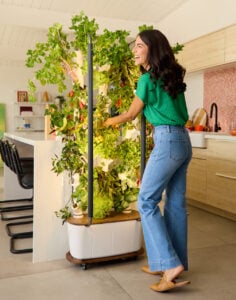
The three things that require active human management in traditional indoor growing are the three things Gardyn’s Hybriponic™ system automates:
Watering
The system’s water pump circulates nutrient solution to every plant on a timed cycle. You fill the reservoir, approximately two gallons, roughly once a week. Kelby notifies you when the level is low. Between refills, watering is completely hands-off.
Lighting
The integrated full-spectrum LED runs on a programmed schedule matched to plant growth stages. Plants receive the right duration and spectrum automatically. You don’t set timers, adjust intensity, or move the system to track sunlight. It simply runs.
Monitoring
Kelby AI watches your plants continuously through the app. Rather than inspecting leaves for yellowing, wilting, or pest signs yourself, you receive a notification when something needs attention. Most of the time, for most growers, Kelby’s status is green. You check the app, see everything is healthy, and move on. The monitoring work is done for you.
For a detailed breakdown of exactly what the weekly time commitment looks like, see: the 5-minute daily garden: what indoor growing actually takes.
Comparing low-maintenance indoor growing options
| System | Capacity | Light | Watering | Monitoring | Weekly effort |
| Windowsill herb pots | 3–5 pots | Natural only | Manual daily/every 2 days | None, visual inspection | 15–20 min |
| Small pod systems (3–9 pods) | 3–9 plants | Integrated LED | Reservoir, ~weekly | Basic alerts | 5–10 min |
| Gardyn Studio | 16 plants | Integrated LED | Reservoir, ~weekly | Kelby AI continuous | 5–10 min |
| Gardyn Home | 30 plants | Integrated LED | Reservoir, ~weekly | Kelby AI continuous | 5–10 min |
The maintenance difference between a windowsill setup and a Gardyn system is significant: daily watering decisions vs a weekly reservoir refill, no light management vs automated LED, no monitoring vs Kelby’s continuous watch. For someone who wants genuine low-maintenance food growing, the automated system is materially different : not just a convenience upgrade.
The “set it and come back in a month” test
A useful way to evaluate any growing system’s true maintenance level: what happens if you pay almost no attention for 30 days?
Windowsill herb pots: dead within a week to ten days in most cases, depending on pot size and climate.
Small pod systems: survive longer than pots, but will need reservoir attention within a week and may show stress without monitoring.
Gardyn with vacation mode: a full reservoir before departure, vacation mode enabled in the app, and the system manages itself for up to two weeks. Kelby monitors continuously and can alert a trusted contact if anything needs attention. A month is beyond what any system handles without a water refill, but two weeks of genuine inattention is built in. See: vacation mode: a game changer for gardening.
|
Frequently asked questions
What is the easiest indoor food plant to grow?
For beginners in an automated system: basil and arugula are the fastest and most forgiving, visible progress within days, first harvest in 3 weeks. Chives are the most structurally indestructible; they regrow rapidly after every harvest. In a traditional pot setup without automation, low-light-tolerant herbs like mint and chives are the most forgiving of irregular care.
How little attention does a Gardyn system actually need?
The non-negotiable weekly task is refilling the water reservoir, approximately two gallons, once a week, 60–90 seconds. Kelby handles monitoring and alerts for everything else. Harvesting (the enjoyable part) takes a few minutes per week when plants are in active production. Total weekly active time for most owners: 5–10 minutes.
What’s the difference between a Gardyn and a self-watering planter?
A self-watering planter is a soil-based container with a reservoir that wicks moisture upward, it extends the interval between waterings but still requires regular refilling and provides no light management or monitoring. Gardyn’s Hybriponic™ system is a fully automated hydroponic system with integrated LED lighting, automated water cycling, and AI-powered plant monitoring. The self-watering planter reduces one task; Gardyn automates the three most critical ones.
Can I go on vacation without killing my Gardyn?
Yes, vacation mode adjusts the system’s operating cycle for periods when plants aren’t being actively harvested. Fill the reservoir fully before you leave, enable vacation mode in the Kelby app, and most plants handle 10–14 days comfortably. For longer absences, someone checking in to refill water once is usually sufficient to maintain healthy plants.
Are there truly low maintenance indoor edible plants?
In an automated system, yes, basil, chives, arugula, mint, and butterhead lettuce all grow productively with minimal human input. In a traditional pot setup, “low maintenance and productive” is harder to achieve: the plants need light and consistent water, and without automation, those needs fall on you. The automation is what makes food growing genuinely low maintenance, not the plant selection alone.