Cookies help us deliver the best experience on our website. By clicking Accept you are agreeing to the placement and use of cookies as described in our privacy policy.


If you’ve ever watched a herb plant stretch awkwardly toward a window, or seen basil go pale and leggy indoors, you’ve witnessed a plant that isn’t getting the light it actually needs. Most indoor spaces, even bright, south-facing apartments, don’t provide enough of the right kind of light for food crops to thrive year-round. Understanding why comes down to the science of light spectrum, and it explains why the right grow light makes all the difference between a struggling plant and a productive one.
Key takeaways
- Plants don’t just need brightness, they need specific wavelengths of light, particularly red and blue, to drive photosynthesis and healthy growth.
- Full spectrum LED grow lights replicate the wavelength range of natural sunlight, giving indoor plants everything they need without a
sunny window. - Light intensity, duration, and distance from the plant all affect growing outcomes as much as light quality.
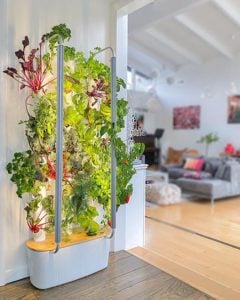
- Gardyn’s integrated full-spectrum LED panels are calibrated for the specific plants in each yCube, running on AI-optimized schedules : no setup, no guessing.
- Herbs, leafy greens, and fruiting plants each have different light requirements; understanding these helps you grow more successfully indoors.
Why indoor plants struggle without the right light
Plants are solar-powered machines. Every leaf, stem, and root exists to support one core process: capturing light energy and converting it into food. But “light” isn’t a single thing, it’s a spectrum of wavelengths, and plants are selective about which ones they use.
Sunlight contains the full spectrum of visible light plus wavelengths beyond human vision. When sunlight passes through a window, the glass filters out some wavelengths, reduces intensity, and shifts the angle throughout the day. On overcast days or in winter, available light drops further. A plant sitting on a windowsill might receive adequate light for survival but not for productive growth : the difference between a plant that stays alive and one that thrives.
What happens when light is insufficient
The signs of light stress in plants are easy to recognize once you know what to look for:
- Etiolation: stems stretch long and weak toward the light source, leaves spread wide and thin. The plant is desperately searching for more photons.
- Pale or yellowing leaves: chlorophyll production decreases when light is insufficient, draining the deep green color that signals a healthy, productive plant.
- Slow growth or failure to fruit: without adequate light energy, plants prioritize survival over production. Herbs go to seed early; tomatoes and peppers won’t set fruit.
- Leggy basil: the classic indoor gardening frustration. Basil needs high light intensity, more than most windowsills provide, to grow bushy and productive rather than tall and sparse.
The light spectrum plants actually use
Visible light spans wavelengths from roughly 380nm (violet) to 700nm (red). Plants absorb light across this range, but their chlorophyll pigments are most efficient at two specific regions: blue wavelengths (around 400–500nm) and red wavelengths (around 600–700nm). These aren’t the only wavelengths plants use, but they’re the ones that matter most for photosynthesis and growth.
Blue light (400–500nm): structure and vegetative growth
Blue light drives vegetative growth : the development of leaves, stems, and root systems. It’s the dominant wavelength during spring and early summer when the sun is lower in the sky. Plants use blue light to regulate their growth direction (phototropism), control stomatal opening for gas 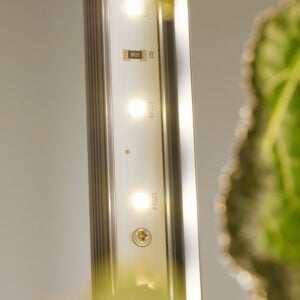 exchange, and build the dense, compact structure that makes for a healthy, harvestable plant.
Insufficient blue light is a primary cause of the legginess and stretching you see in indoor herbs. The plant is reaching for blue wavelengths it isn’t getting.
Red light (600–700nm): flowering and fruiting
Red light drives photosynthesis most efficiently and is critical for flowering and fruiting. It’s the dominant wavelength of late summer and autumn sunlight : the signal plants use to prepare for reproduction. For food crops, adequate red light is what triggers fruiting in tomatoes and peppers, and what drives the rapid leaf growth that makes herbs and greens so productive.
Far-red light (700–800nm): plant signaling
Just beyond the visible red spectrum, far-red wavelengths act as plant signaling cues, regulating germination, flowering time, and the “shade avoidance” response (the stretching behavior plants exhibit when competing for light). Quality full-spectrum grow lights include some far-red output to ensure plants behave normally and don’t interpret the artificial light environment as shade.
Green light (500–600nm): the overlooked wavelength
Plants reflect much of the green spectrum (which is why they appear green to our eyes), but they do absorb and use green light, particularly in lower leaf layers that blue and red light don’t penetrate as deeply. Full spectrum lights include green wavelengths to ensure whole-plant photosynthesis rather than just surface-level light absorption.
| Wavelength | Range | Primary function | Deficiency symptoms |
|---|---|---|---|
| Blue | 400–500nm | Vegetative growth, compact structure | Stretching, legginess, pale leaves |
| Green | 500–600nm | Deep leaf penetration, full-plant photosynthesis | Reduced lower leaf productivity |
| Red | 600–700nm | Photosynthesis efficiency, flowering, fruiting | Slow growth, failure to fruit |
| Far-red | 700–800nm | Plant signaling, germination, shade response | Abnormal flowering timing |
Full spectrum vs. single-spectrum grow lights
Early indoor grow lights were often single-spectrum, either blue or red, based on the assumption that plants only needed those two wavelengths. The results were functional but not optimal: plants grew, but often with abnormal structure, off colors, or reduced yields. Full spectrum lights changed this by delivering wavelengths across the entire range plants use, including green and far-red, producing results much closer to natural sunlight.
 Why ‘full spectrum’ isn’t a regulated term
The term “full spectrum” isn’t standardized or regulated in the grow light industry. Some manufacturers use it to mean any light that covers multiple wavelengths; others use it to mean a specific, scientifically calibrated spectrum. When evaluating grow lights, look for PAR output data (Photosynthetically Active Radiation : the measurement of light energy in the wavelengths plants actually use) rather than relying on “fullspectrum” marketing language alone.
LED vs. fluorescent vs. HID grow lights
Modern LED grow lights have largely replaced fluorescent and HID (High-Intensity Discharge) options for home growing. LEDs produce less heat, consume significantly less electricity, last longer, and can be tuned to deliver precise wavelength distributions. For a vertical indoor garden in a living space, heat and energy efficiency aren’t just technical specs, they’re practical concerns that affect comfort and operating costs.
|
Light intensity, duration, and distance
Spectrum quality is one part of the equation. Three other factors determine whether your plants actually thrive under a grow light: intensity (how much light), duration (how long), and distance (how far the light source is from the plant).
Light intensity: PPFD and DLI
Photosynthetic Photon Flux Density (PPFD) measures the amount of PAR light reaching a surface per second, expressed in μmol/m²/s. Daily Light Integral (DLI) measures the cumulative amount of PAR light received over a full day. These are the metrics that actually predict plant performance : not wattage, not lumens (which measure brightness as humans perceive it, not as plants use it).
Different plants have different PPFD requirements. Leafy greens and herbs generally need 200–400 μmol/m²/s; fruiting plants like tomatoes and peppers need 400–600+. Understanding these requirements is part of why a one-size-fits-all grow light often underperforms for certain plant types.
Photoperiod: how many hours of light do plants need?
Most food crops are “day-neutral” for practical growing purposes, they don’t require a specific day length to grow, though they respond well to 14–16 hours of light per day. Some plants, including certain herbs, will bolt (go to seed) if given too many hours of continuous light. Getting this balance right manually requires tracking and adjustment.
Gardyn’s Kelby AI sets and maintains optimized photoperiod schedules for each plant variety automatically : one of the practical advantages of a smart garden system over manual grow light setups.
Distance from the light source
 Light intensity follows the inverse square law: double the distance from a light source and you get one-quarter of the intensity. This means that plants at the top of a grow shelf and plants at the bottom receive dramatically different light levels unless the lighting system is specifically designed to compensate. For vertical growing systems, this is a critical design consideration, and one that external grow lights handle poorly without careful positioning and multiple fixtures.
Gardyn’s systems include integrated LED panels that run the full height of the column, ensuring every plant site, top to bottom, receives consistent light intensity. This is a core advantage over trying to light a vertical growing setup with an external fixture. See how it works on the Gardyn how it works page.
Light requirements by plant type
Not all plants need the same amount of light. Knowing your plant’s light requirements helps you set realistic expectations and choose the right setup.
High light plants (400–600+ μmol/m²/s)
Fruiting plants evolved in open, sunny environments and need the highest light intensity to produce well indoors.
- Cherry tomatoes, need consistent high light for fruit set; compact varieties perform best
- Jalapeños and sweet peppers : slow to mature but productive with adequate light
- Mini strawberries, need full spectrum light including far-red for proper fruiting signals
- Cucumbers, high light, high reward; vertical format suits their natural climbing habit
Medium light plants (200–400 μmol/m²/s)
Most culinary herbs and leafy greens fall into this category, productive with moderate light and good spectrum quality.
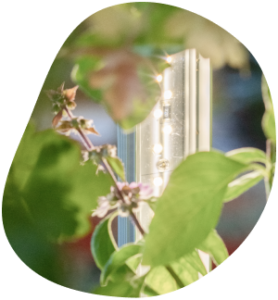
- Basil, sweet Thai basil, and purple basil, need more light than most herbs; prone to legginess if light is insufficient
- Cilantro, bolts quickly under excessive light or heat; moderate light extends harvest window
- Arugula, butterhead lettuce, and romaine : fast-growing with consistent medium light
- Kale and Lacinato kale, tolerates moderate light; nutrient density benefits from consistent spectrum
Lower light tolerant plants (100–200 μmol/m²/s)
Some herbs evolved in partially shaded conditions and perform well with less intense light.
- Mint, vigorous grower even with lower light intensity; excellent for beginners
- Chives, tolerant and consistent; one of the most forgiving indoor crops
- Italian parsley : slower to establish but productive with moderate light
- Thyme and oregano, Mediterranean herbs that evolved in bright but not intense light conditions
| Plant category | Light need | Key wavelengths | Gardyn performance |
|---|---|---|---|
| Fruiting plants | High (400–600+ μmol/m²/s) | Red + far-red dominant | Excellent with full-spectrum LEDs |
| Culinary herbs | Medium (200–400 μmol/m²/s) | Blue + red balanced | Optimal, default yCube configuration |
| Leafy greens | Medium (200–400 μmol/m²/s) | Blue dominant for leaf structure | Fastest harvest cycles |
| Shade-tolerant herbs | Lower (100–200 μmol/m²/s) | Broad spectrum, lower intensity | Very reliable; great for beginners |
Why Gardyn’s integrated lighting works
Most indoor growing guides end with a recommendation to buy a grow light, mount it, set a timer, and adjust positioning as plants grow. That’s a reasonable approach for experienced growers with dedicated grow spaces. For everyone else, people who want fresh herbs and greens in their kitchen without a horticulture degree, it’s a friction-filled process with a lot of ways to get it wrong. Gardyn’s Hybriponic™ technology integrates lighting directly into the system architecture, eliminating each of those friction points.
Calibrated for the plants you’re growing
Each yCube plant variety has been tested and calibrated within Gardyn’s growing environment. The LED spectrum, intensity, and photoperiod schedule are optimized for the specific plants you’re growing : not a generic ‘indoor plants’ setting. This is a meaningful difference: basil and mint have different light requirements, and Kelby accounts for both.
Consistent top-to-bottom coverage
In a vertical growing column, ensuring that plants at every level receive adequate, consistent light is an engineering challenge. Gardyn’s integrated panel design runs the full height of the system, maintaining consistent PPFD across all plant sites, from the topmost pod to the lowest.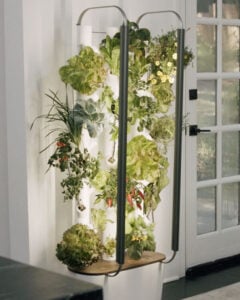 External grow lights positioned above a system can’t replicate this without careful multi-fixture setups.
Automated photoperiod management
Kelby AI sets and maintains light schedules automatically, adjusting for growth stage and plant variety. You don’t set timers, you don’t monitor day length, and you don’t need to remember to turn lights on and off. For frequent travelers or busy households, this automation is one of the most practical benefits of the system.
| See Gardyn’s full-spectrum lighting in action |
| Learn how Gardyn’s integrated LED system and Kelby AI work together to optimize plant growth : no separate lights, no manual scheduling. How it works → |
Frequently asked questions
What does ‘full spectrum’ mean in grow lights?
Full spectrum grow lights emit wavelengths across the range plants use for photosynthesis, from blue (400–500nm) through red (600–700nm) and often including far-red (700–800nm). Unlike single-color grow lights that emit only one wavelength range, full spectrum lights replicate the broad distribution of natural sunlight, supporting all phases of plant growth rather than just one.
Can I use a regular LED bulb to grow plants indoors?
Standard LED bulbs are designed to produce light the human eye perceives as bright and comfortable, they’re optimized for lumens, not PAR output. They emit some wavelengths plants use but lack the spectrum balance and intensity that food crops need. For herbs and greens, you’ll see significantly better results with a purpose-built grow light than with standard household bulbs.
How many hours of light do indoor plants need?
Most food crops, herbs, leafy greens, and fruiting plants, perform well with 14–16 hours of light per day. Some herbs like cilantro can bolt (go to seed) with too many hours of continuous light. Gardyn’s Kelby AI manages photoperiod automatically for each plant variety, so you don’t need to set or monitor light schedules.
How close should grow lights be to plants?
The ideal distance depends on light intensity, too close and you risk light burn; too far and intensity drops off steeply. For most home LED grow lights, 6–18 inches is the typical range, with adjustments needed as plants grow. Gardyn’s integrated system eliminates this variable : the LED panels are positioned by design for the column layout, and no adjustment is ever needed.
Are LED grow lights expensive to run?
Modern LED grow lights are significantly more energy-efficient than older HID or fluorescent options. Gardyn’s integrated LEDs typically add $5–15 per month to an electricity bill depending on local rates and usage hours. Given that a single Gardyn system can replace dozens of herb and produce purchases, the economics are favorable for most regular users.
Do plants need darkness as well as light?
Yes, plants use dark periods for rest, respiration, and certain metabolic processes. The optimal cycle for most food crops is 14–16 hours of light followed by 8–10 hours of darkness. Running grow lights 24/7 can actually stress certain plants and disrupt normal growth cycles. Gardyn’s automated schedules maintain the correct light/dark ratio for each plant variety.
Can grow lights replace sunlight completely?
For food crops indoors, yes, quality full-spectrum grow lights can fully replace sunlight when properly calibrated for spectrum, intensity, and duration. This is the entire premise of indoor hydroponic growing, and it’s why Gardyn members can grow herbs, greens, and fruiting plants year-round regardless of season, climate, or window orientation.
What plants grow best under full spectrum grow lights?
Herbs and leafy greens are the most productive and fastest-cycling plants under full spectrum grow lights. Fruiting plants like cherry tomatoes, peppers, and mini strawberries also thrive with adequate intensity. Browse Gardyn’s complete plant catalog to see which varieties are available as pre-seeded yCubes.