Cookies help us deliver the best experience on our website. By clicking Accept you are agreeing to the placement and use of cookies as described in our privacy policy.


No yard. No outdoor space. Maybe a window that faces the wrong direction, a building super who frowns on balcony modifications, and a kitchen that was designed for reheating takeout rather than growing food. Sound familiar?
This is the daily reality for millions of apartment dwellers who want to grow their own food but assume the lack of a yard makes it impossible. The assumption is wrong, and it’s been wrong for longer than most people realize. What’s changed is that smart growing technology has made apartment gardening not just possible but genuinely easy, producing results that outdoor gardens in good climates often can’t match.
This is the complete guide to indoor gardening for apartment dwellers: how to work with limited space, limited light, and the constraints of rental living to grow fresh food at home year-round.
Key takeaways
- A yard is not required for productive food growing : an apartment kitchen can support 16–30 plants in as little as 1.4–2 square feet.
- The biggest apartment gardening challenges, insufficient light, limited space, and watering inconsistency, are all solved by smart growing systems.
- Gardyn Studio was designed specifically for smaller spaces: 16 plants in 1.4 square feet, quiet operation, no soil mess, and no modifications to your apartment.
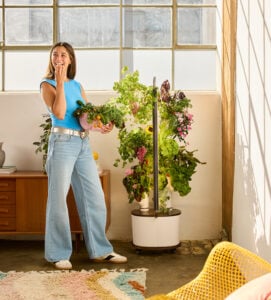
- Vertical growing is the key strategy for apartments, maximizing yield per square foot rather than spreading horizontally.
- Most apartment growers start harvesting herbs and greens within 4–6 weeks of setup.
- Indoor growing is completely seasonal-independent, you grow year-round regardless of weather, climate, or what floor you’re on.
The real challenges of apartment gardening, and how to solve them
Before jumping into what to grow, it’s worth being direct about the challenges that make apartment gardening feel difficult, because the solutions are specific and practical, not vague encouragement.
Challenge 1: not enough light
This is the most common reason apartment gardens fail. Most apartment windows, especially in dense urban areas where neighboring buildings block sun angles, don’t deliver the sustained, intense light that productive food plants need. East-facing windows get gentle morning light but not the intensity needed for fruiting plants. North-facing windows are insufficient for almost everything edible. Even good south-facing exposure is compromised in winter when the sun sits lower.
The complete solution: full-spectrum LED grow lights. Modern grow lights are tuned to the wavelength ranges plants need most for photosynthesis, draw minimal electricity, generate very little heat, and are available in forms that integrate cleanly into home spaces. In Gardyn’s system, integrated LED lighting runs automatically on an optimized 16-hour cycle : no timers, no positioning adjustments, and no dependence on your building’s window orientation whatsoever.
Challenge 2: space constraints
The instinct in small spaces is to spread out : a pot here, a container there, a windowsill planter, a balcony box. The problem is that this approach produces very little food relative to the space and maintenance it consumes, and it looks chaotic rather than intentional.
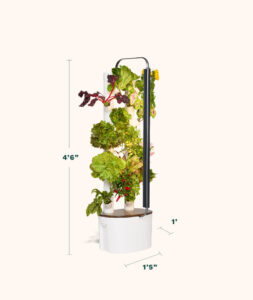
The complete solution: vertical growing. Going vertical, stacking plant capacity upward rather than outward, is the single most effective strategy for apartment food growing. Gardyn Studio grows 16 plants in a 1.4 square foot footprint by stacking pods vertically in a column format that fits in a corner of a kitchen or against a wall. Gardyn Home grows 30 plants in 2 square feet. These are meaningful food quantities, enough for regular salads, abundant fresh herbs, and supplementary vegetables, in the footprint of a small nightstand.
Challenge 3: rental restrictions
Soil in an apartment creates mess that can damage flooring and fixtures. Wall-mounted systems require holes and hardware that most leases prohibit. Balcony weight limits restrict large container setups. Many renters are one spilled pot of soil away from losing their security deposit.
The complete solution: soil-free growing. Gardyn’s Hybriponic™ technology grows everything in water : no soil, no mess, no flooring risk. The system is freestanding and requires no wall mounting, no drilling, and no permanent modifications. It plugs into a standard outlet. When you move, it moves with you. The entire system is renter-friendly by design.
Challenge 4: inconsistent attention
Apartment life is often unpredictable. You travel for work. You have long days. You forget to water for a week. Traditional soil gardening punishes inconsistency severely, missed waterings cause stress or death, and irregular attention produces poor yields.
The complete solution: smart automation. Gardyn’s Kelby AI monitors each plant continuously and notifies you when the water reservoir needs topping up, typically once a week, taking less than a minute. The automated lighting handles itself. The closed-loop water system prevents overwatering entirely. You can travel for a week and return to a healthy garden, something traditional indoor gardening makes extremely difficult.
Finding the right spot in your apartment
With a system that provides its own light and requires only a power outlet, placement flexibility in an apartment is nearly unlimited. That said, some locations work better than others.
Kitchen placement: the most practical choice
The kitchen is the obvious location, proximity to where you cook means you’ll actually use what you grow. A corner counter, the end of a kitchen island, or the space beside a refrigerator all work well. Gardyn Studio’s narrow 1.4 square foot footprint fits in spaces that would otherwise hold nothing useful.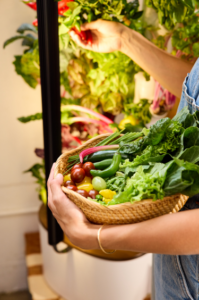
Dining and living areas: garden as decor
Gardyn systems are designed to look intentional rather than makeshift. Several customers describe placing their unit as a design feature in a dining room or living area : the lush vertical column of 16 or 30 plants is genuinely attractive. This is particularly useful in studio apartments where the kitchen-living boundary is blurred.
What to avoid
Keep the system away from heating vents and air conditioning units, temperature swings of more than 10°F stress plants and slow growth. Avoid areas with very low ambient humidity if possible; a small humidifier nearby helps moisture-loving plants like basil thrive. Don’t place the system anywhere you can’t easily access the water reservoir from the base, topping up weekly is the primary maintenance task.
The best plants for apartment growing
With full-spectrum lighting handled by the system, virtually any plant available as a Gardyn yCube is viable in an apartment setting. The practical considerations for apartment dwellers are slightly different from house growers, prioritize high-use, compact, and continuous-harvest plants that maximize daily value from limited pod capacity.
High-priority herbs for apartment kitchens
Herbs deliver the highest culinary return per pod because even small harvests elevate cooking significantly. Start here:
- Basil : the most-used culinary herb in most households, ready in 3–4 weeks, and continuously productive with regular harvesting
- Mint, extraordinarily versatile: tea, cocktails, sauces, and garnishes; grows vigorously with minimal attention
- Chives, snip and regrow, snip and regrow; one of the lowest-maintenance herbs with consistent production
- Cilantro : essential in Mexican, Indian, and Southeast Asian cooking; fast to produce and succession-plantable
- Italian parsley, versatile finishing herb that appears in nearly every cuisine; longer-lived than cilantro
- Thyme : slow to start but extremely hardy and long-lived; set it and forget it once established
Greens for daily salads and cooking
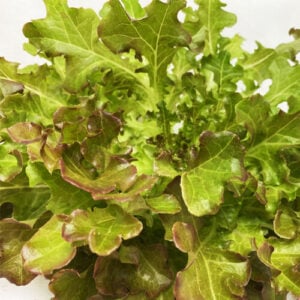 A mix of lettuce and greens varieties produces continuous, overlapping harvests, meaning you’re always a step away from salad ingredients:
- Butterhead lettuce, sweet and tender, ready in 3–4 weeks; harvest outer leaves continuously
- Arugula, peppery and nutrient-dense; fast-growing and productive; excellent on pizza and pasta
- Romaine, sturdy leaves that hold up in salads and wraps; consistent performer in hydroponic systems
- Kale, among the most nutritionally dense greens available; harvest outer leaves over many weeks
- Red Swiss chard, colorful, productive, and excellent both raw and sautéed
Fruiting plants for the adventurous apartment grower
Fruiting plants take longer and need more resources, but the payoff, home-grown tomatoes and peppers from a 2-square-foot kitchen garden, is remarkable:
- Cherry tomatoes, compact variety optimized for indoor growing; 6–8 weeks to first harvest; prolific producers once established
- Jalapeños, highly productive, slow to peak but then continuously fruiting for months
- Mini strawberries : a genuine conversation piece and a hit with anyone who visits; slower to produce but deeply satisfying
Choosing between Gardyn Studio and Gardyn Home for apartment living
Both Gardyn systems are viable in apartments : the right choice depends on your kitchen size, how many people you’re growing for, and your ambitions for what you want to produce.
| Gardyn Studio | Gardyn Home | |
|---|---|---|
| Plant capacity | 16 yCubes | 30 yCubes |
| Footprint | 1.4 sq ft | 2 sq ft |
| Starting price | ~$449 | ~$899 |
| Best apartment use case | Solo growers, couples, smaller kitchens | Families, food-focused households, larger spaces |
| Weekly water use | ~1.5 gallons | ~2 gallons |
| Time to first harvest | 4–6 weeks | 4–6 weeks |
| Noise level | Near-silent | Near-silent |
| Renter-friendly | Yes : no drilling, no soil, freestanding | Yes : no drilling, no soil, freestanding |
Not sure which is right for your space? Compare both systems →
Maximizing yield in a small space
With a fixed number of pods, strategic plant selection and rotation is the key to getting the most out of your apartment garden. Here are the principles that experienced apartment Gardyn users rely on.
Mix fast and slow growers
Fill most pods with fast-cycling plants (lettuce, basil, cilantro : ready in 3–5 weeks) alongside a few slower long-term producers (rosemary, thyme, cherry tomatoes). This creates overlapping harvest windows so there’s always something ready to pick while other plants are still developing.
Succession plant your highest-use herbs
For herbs you use constantly, particularly cilantro, which bolts (goes to seed) after a few weeks, replace one pod every 2–3 weeks rather than all at once. This ensures you’re never without a fresh supply. With yCube pods, swapping in a new pod takes about ten seconds.
Harvest aggressively and often
The single behavior change that most dramatically increases apartment garden productivity is harvesting more frequently. Many new growers are too cautious, afraid of taking too much. For herbs, harvesting from the top regularly prevents bolting and encourages bushier, more productive growth. For lettuces, outer-leaf harvesting allows the plant to keep producing for weeks. The more you harvest, the more you grow.
Rotate seasonal priorities
One of the advantages of growing indoors is that you’re not locked into any season, but you can still adjust your mix to match cooking patterns. In cooler months, lean into heartier greens like kale, chard, and romaine alongside warming herbs like thyme, rosemary, and sage. In warmer months, shift toward basil, cherry tomatoes, peppers, and cucumbers. Browse the full yCube plant library to plan seasonal mixes.
Apartment gardening and building rules
Lease considerations
A Gardyn system requires no modifications to your apartment : no wall mounting, no drilling, no structural changes. It’s a freestanding appliance that plugs into a standard electrical outlet and uses approximately the same electricity as a small lamp. There is no soil, no drainage risk, and no mess that could damage flooring or surfaces. This profile puts it in the same category as a coffee maker or standing fan in terms of lease compliance, virtually no lease restriction would apply to it.
Water and drainage
The closed-loop water reservoir means there’s no drainage or runoff. You add water to the reservoir (approximately 2 gallons per week); the system recirculates it to the plants. There’s no need for floor drainage, trays, or overflow containment. This is genuinely apartment-friendly in a way that soil container gardening never is.
Noise and light considerations for shared walls
Gardyn systems operate near-silently : the water circulation pump produces a gentle background hum comparable to a fish tank. The integrated grow lights are bright when viewed directly (comparable to a desk lamp) but don’t emit light beyond the immediate area of the unit. Neither factor typically causes issues in apartment settings.
|
Frequently asked questions
Can you grow vegetables in an apartment without sunlight?
Yes, full-spectrum LED grow lights replicate the wavelengths plants need for photosynthesis and completely replace the need for natural sunlight. Gardyn’s integrated lighting runs on an automated 16-hour cycle optimized for edible plants. Your apartment’s window orientation, floor number, and surrounding buildings are completely irrelevant. You can grow an abundant indoor garden in a basement apartment or a windowless interior unit.
What is the best indoor garden for a small apartment?
Gardyn Studio is purpose-built for small apartment spaces, 16 plants in a 1.4 square foot footprint, with near-silent operation, no soil, and no permanent modifications to your unit. It fits on a kitchen counter, in a dining corner, or against a living area wall. For households with more space and appetite for larger yields, Gardyn Home grows 30 plants in 2 square feet.
Is apartment gardening worth it?
For households that cook regularly and use fresh herbs and greens frequently, apartment gardening delivers genuine value on multiple dimensions. The quality of produce consumed immediately after harvest is higher, in both flavor and nutrition, than anything available at a grocery store. Over a Gardyn system’s lifecycle, a single yCube pod produces significantly more usable produce than the equivalent grocery store purchase would cost. And practically, having herbs and greens always available changes cooking habits for the better, people reach for fresh ingredients when they’re right there rather than substituting dried or skipping the step entirely.
How much space do I need for an indoor garden in an apartment?
Gardyn Studio requires 1.4 square feet of floor or counter space plus approximately 5.5 feet of vertical clearance. Gardyn Home requires 2 square feet and approximately 6 feet of vertical clearance. Both systems are freestanding : no wall space required.
What plants grow well in a north-facing apartment?
With natural light alone, north-facing apartments are challenging for most edible plants. However, with a grow light or a Gardyn system, north-facing orientation is irrelevant : the system provides its own light. Italian parsley, mint, chives, and kale are the most tolerant of lower natural light if you’re using a windowsill setup without a grow light. For any serious food production in a north-facing apartment, integrated grow lighting is the only reliable solution.
Can you grow tomatoes in an apartment?
Yes, cherry tomatoes grow productively in Gardyn’s indoor hydroponic system. They need more light and a longer grow time (6–8 weeks to first harvest) than herbs and greens, but the Gardyn system’s integrated LED lighting provides the intensity they need. Many apartment Gardyn growers run cherry tomatoes as a permanent fixture in 2–3 pods, replacing them when the plants finish their productive cycle.
How do I keep my apartment garden watered when I travel?
A Gardyn system’s closed-loop reservoir typically holds enough water to sustain plants for 7–10 days without any attention, meaning short trips don’t require any special preparation. For longer absences, Kelby AI can alert a trusted contact to top up the reservoir. Kelby’s Vacation Mode feature adjusts plant care parameters automatically to reduce consumption during extended periods away. This is one of the most significant practical advantages of smart hydroponic growing for people with active lifestyles.
Does an indoor garden smell or attract pests in an apartment?
Fresh herbs produce pleasant, culinary aromas, basil, mint, and rosemary are noticeably fragrant when actively growing, which most users find desirable rather than intrusive. Because the Gardyn system grows in a soil-free, enclosed water reservoir, it eliminates the two most common sources of pest problems in indoor container gardening: fungus gnats (which breed in moist soil) and spider mites (which thrive in dusty, dry growing media). Hydroponic apartment gardens are dramatically less likely to develop pest issues than soil-based approaches.
Can I use a Gardyn system in a studio apartment?
Gardyn Studio was designed with studio apartments explicitly in mind. Its small footprint, clean visual design, and quiet operation make it well-suited to open-plan studio living. Several Gardyn customers in studio apartments describe it as both a functional kitchen tool and an aesthetic element : the lush vertical column of growing plants is more attractive than most alternatives for filling a corner or accent wall.
|