Cookies help us deliver the best experience on our website. By clicking Accept you are agreeing to the placement and use of cookies as described in our privacy policy.


Earth Day 2026 arrives on April 22 with a theme that reads less like a slogan and more like an argument: Our Power, Our Planet. The official manifesto from EARTHDAY.ORG frames it as a rallying call for people-powered environmental action during a period of unusual policy uncertainty. The point is not that individuals need to save the planet by themselves. It is that environmental progress does not depend on any single administration or election. It depends on daily decisions made by communities, households, and people.
The language is deliberate. The 2026 theme is a response to the observation that top-down policy can shift quickly in either direction, but durable change comes from what people actually do in their homes, workplaces, and neighborhoods, repeated over months and years.
Most of the commentary around the theme focuses on voting, protest, and civic engagement. Those matter. But there is a quieter version of individual power that is worth naming on Earth Day, because it is the one that repeats most often in most people’s lives. It happens at the kitchen counter, at the grocery aisle, and in the fridge. And it happens hundreds of times a year.
Key takeaways
- The Earth Day 2026 theme is Our Power, Our Planet, focused on sustained community-led action rather than one-time gestures.
- Food decisions are among the most frequent household choices, which is exactly why they compound faster than most other individual actions.
- Five food-system shifts carry outsized environmental weight: shortening the supply chain, eliminating clamshell packaging, harvesting rather than buying, stopping the spoilage cycle, and diversifying the plants you grow.
- A three-tier action ladder – one thing today, one this week, one this year – turns Earth Day from a single event into a year-round habit.
What ‘Our Power, Our Planet’ actually means
The first Earth Day, on April 22, 1970, drew about 20 million Americans into the streets. That single day is widely credited with catalyzing the Clean Air Act, the Clean Water Act, and the creation of the EPA within the next few years. It was, in retrospect, one of the most productive civic mobilizations in modern American history.
The 2026 theme invokes that history on purpose. EARTHDAY.ORG’s 2026 manifesto argues that the protections built in the 1970s are being actively rolled back, and that the same kind of people-powered action that created them is what will defend and rebuild them. The framing is more confrontational than recent Earth Day themes like Invest in Our Planet or End Plastic Pollution, which leaned more toward corporate and consumer behavior change.
The shift matters. It reminds people that individual action is not a substitute for collective action. Voting, organizing, and policy engagement do the heaviest lifting. But collective action is made up of individuals, and individuals need somewhere to start. For most people, that somewhere is the home.
| “Your power is not in the occasional grand gesture. It is in the hundred small food choices you make every week.” |
Where individual power actually compounds: the plate
 A single household makes hundreds of environmental decisions a year. Most of them are food-related. How many grocery trips you take. What you buy. How much of it you eat. How much you throw away. What packaging it came in. How far it traveled.
Few other individual decisions repeat at that frequency. You buy a car every decade. You replace a refrigerator every fifteen years. You change your heating system once or twice in a lifetime. But you make food choices roughly 1,000 times a year, and each one has a measurable, if modest, environmental footprint.
That repetition is where the power sits. A shift that seems trivial applied once becomes meaningful applied 1,000 times. Skipping one clamshell of spring mix per week, for instance, adds up to 52 plastic containers diverted from the waste stream over a year. Doing it for a decade is 520. Food is the single largest category of material sent to American landfills, and produce packaging is a significant contributor to that.
The 2026 Earth Day theme is, at heart, a statement about the cumulative power of small repeated decisions. Food is where most of those decisions live.
Five food-system shifts that actually matter
Not generic advice. Each of the following has a specific mechanism and a specific payoff. None of them require a lifestyle overhaul.
- Shorten your produce supply chain
The average American leafy green travels 1,500 to 2,500 miles from farm to plate, most of it by refrigerated truck. Every mile carries emissions, fuel cost, and nutrient loss. Shortening that chain by buying local, buying less often, or growing at home reduces all three at once. For context, a head of butterhead lettuce harvested in your kitchen has traveled zero miles and is at peak nutrition. The same lettuce bought at a grocery store may be ten days old.
- Eliminate clamshell packaging from your habits
Most produce packaging is technically recyclable and practically not, because contamination and material thickness disqualify it from curbside programs. Herbs are particularly bad offenders. Pre-packaged basil, cilantro, and mint typically come in single-use clamshells that get used once and then thrown away. If your household buys three packaged herb containers a week, you are discarding roughly 150 plastic containers a year just on garnishes.
- Harvest rather than buy
This is the clearest example of how individual power compounds. When you harvest from a plant, you take only what you need at the moment you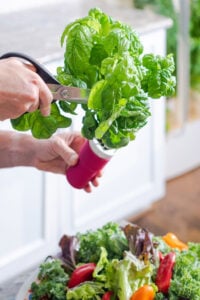 need it. There is no pre-purchased inventory to manage, no spoilage window, no guessing about what to cook this week. Fresh cherry tomatoes, kale, and arugula picked minutes before a meal are the operating reality of a Gardyn Home, and they eliminate the refrigerator-graveyard cycle that most households quietly accept as normal.
- Stop the spoilage cycle
The USDA estimates the average American family of four loses about $1,500 a year to uneaten food. Leafy greens are at the top of the waste pile because they spoil fastest. The remedy is not to buy more, it is to buy less and eat it sooner, or to bypass the cycle entirely by growing what you use. Our team has written in detail about stopping the $60-a-month spoiled produce cycle and how to store fresh herbs so they actually last.
- Diversify the plants you grow, not just what you buy
Industrial agriculture concentrates on a handful of high-yield varieties. About 75 percent of the world’s food comes from just 12 plant species. Growing less common varieties at home, whether that is red tatsoi, red sorrel, or watercress, is both a nutritional diversification and a small push back against the consolidation of what humans eat.
| A note on scope
None of the five shifts above is sufficient on its own. They are additive. The point is not that any single one changes the world, but that applied in combination, 1,000 times a year, they represent a meaningful household-level footprint reduction. Earth Day’s power is in the compounding, not the gesture. |
What to do today, this week, this year
The 2026 theme calls for sustained action, not single-day performance. Here is a simple three-tier ladder, designed to meet you wherever you are.
Today: one decision
 Pick one food swap you can make in the next 24 hours. Skip the clamshell of pre-washed greens. Cook something with whatever produce is about to turn in your fridge. Buy one type of produce you will actually eat, not three you hope to. If you want the lowest-barrier way to start growing your own food today, the Gardyn Microgreens Complete Kit starts at around $99 and produces harvests in 7 to 14 days.
This week: one habit change
Audit your produce waste for seven days. Keep a running list of what you throw out. The number surprises most households, and the behavior change tends to follow the awareness. Alongside that, pick one recurring produce item you will commit to either growing or buying local for the rest of the year. Herbs like basil, cilantro, and chives are the easiest starters because they are used in small amounts and fresh versions are dramatically better than grocery-store packaged ones.
This year: one structural change
The biggest household-level environmental win available to most families is to shift the production of their most-used fresh produce closer to home. For a small apartment, that might mean a Gardyn Studio growing 16 plants at a time in 1.4 square feet. For a family, a Gardyn Home grows up to 30 plants and produces up to 10 pounds of fresh food per month. The environmental case for home growing is covered in depth in our Earth Day anchor piece and across our sustainability content hub. The short version: for leafy greens and herbs specifically, home growing reduces water use by roughly 95 percent, eliminates clamshell packaging entirely, and skips the 1,500-mile supply chain. More specific Earth Day actions are compiled in our 12-point Earth Day checklist.
What this adds up to
Earth Day 2026’s theme is about reclaiming the idea that ordinary people shape the environmental future. That is not an abstract philosophical statement. It is a statement about what happens 1,000 times a year in every household in the country.
The individual shifts named here are not heroic. Skipping a clamshell, growing an herb, eating the lettuce before it turns. None of those will end up on a poster. But that is the point. The biggest environmental wins available to most people are quiet, repeated, and cumulative. Our Power, Our Planet is a reminder that the repeated small thing, done often enough, is where change actually lives.
| Start where your Earth Day power lives.
Whether you begin with the Microgreens Complete Kit, add a Gardyn Studio for small spaces, or commit to a Gardyn Home for your family, each choice compounds. This Earth Day, pick the one that fits and start. |
Frequently asked questions
What is the Earth Day 2026 theme?
The Earth Day 2026 theme is Our Power, Our Planet, announced by EARTHDAY.ORG in January 2026. The theme emphasizes people-powered environmental action during a period of policy uncertainty.
When is Earth Day 2026?
Earth Day 2026 falls on Wednesday, April 22. Earth Week events begin earlier, on Saturday, April 18, to accommodate working people, students, and families.
What does ‘Our Power, Our Planet’ mean?
The theme argues that environmental progress is sustained by daily actions of communities, educators, workers, and families, rather than by any single administration or election. It is framed as a call for ongoing civic and community engagement rather than one-time gestures.
What are the most impactful individual environmental actions?
Peer-reviewed research generally points to four categories: transportation choices (flying less, driving less), diet (eating less meat, wasting less food), energy (efficient heating and cooling, grid decarbonization), and household consumption (reducing new purchases, reducing packaging waste). Food decisions are the most frequent of these, which is why they compound quickly.
How is Earth Day 2026 different from previous years?
The 2026 theme is notably more focused on civic and community action than recent themes like Invest in Our Planet or End Plastic Pollution, which emphasized corporate and consumer behavior. The 2026 framing puts organizing, voter engagement, and policy defense alongside the more familiar community cleanups and tree plantings.
What can I actually do on Earth Day that makes a difference?
Start with one action you can repeat. A single Earth Day cleanup matters, but a habit you keep for a year matters more. Our Earth Day checklist lays out twelve specific, concrete actions that do not just repeat the generic recycling advice.