Cookies help us deliver the best experience on our website. By clicking Accept you are agreeing to the placement and use of cookies as described in our privacy policy.


Most advice about eating healthier focuses on what to eat. This guide focuses on something more fundamental: how to make eating well the default : not a daily act of willpower, by changing the environment where food decisions happen. As a food scientist, the most useful shift I’ve seen in nutrition research over the past decade isn’t about specific foods; it’s about systems.
Key takeaways
- Healthy eating fails as a willpower project. It succeeds as an environment design project, making the healthy choice the easy choice.
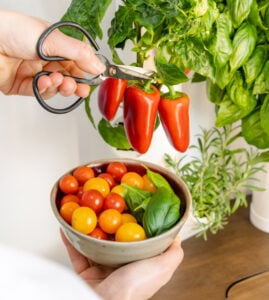
- The most powerful dietary changes are structural: what’s visible, accessible, and already prepared when you’re hungry.
- Eating more vegetables is almost always an accessibility problem, not a preference problem, remove the friction, and consumption increases.
- Having living herbs and greens growing at home changes eating behavior in documented ways: people cook more, use more fresh produce, and report eating better.
- A Gardyn system is a form of nutritional environment design, it puts fresh, harvest-ready vegetables in your kitchen permanently, without a shopping trip or prep time.
Why healthy eating fails (it’s not willpower)
The research on behavior change is consistent on one point: willpower is a depleting resource. People make worse food decisions later in the day, when tired, when stressed, and when hungry. Building a healthy diet around consistent willpower is like building a financial plan around never spending on impulse, technically possible, practically unsustainable.
What works instead: environment design. The goal is to make nutritious choices require less decision-making energy than less nutritious ones, by changing what’s available, what’s visible, and what’s already prepared when you’re in a decision-making moment.
Behavioral economist Brian Wansink’s research (and the substantial body of work that followed) consistently found that people eat what is in front of them, visible, and easy to access, and avoid what requires effort, is hidden, or is inconveniently packaged. The implication: healthy eating is primarily an engineering problem.
The environment design principles
1. Visibility and counter placement
 A classic finding from kitchen research: fruit placed on a kitchen counter (rather than in the refrigerator) is eaten more frequently. The same logic applies to cut vegetables, hard-boiled eggs, prepared hummus, and other ready-to-eat healthy options. If it’s visible when you walk into the kitchen, it gets eaten.
A Gardyn system is a form of visual presence, living herbs and greens growing on your counter or in your kitchen are visible every time you cook, eat, or walk by. The effect on cooking behavior is documented: Gardyn owners consistently report using more fresh herbs and adding more greens to meals because the plants are present and harvestable.
2. Reduce friction for healthy options
Every additional step between hunger and eating a healthy food reduces the probability that the healthy food gets eaten. Washing, chopping, defrosting, cooking, each step is an opportunity for the decision to go differently. The most effective dietary improvement strategies are ones that reduce these steps:
- Batch prep on one day: Cooked grains, washed greens, roasted vegetables, and hard-boiled eggs all require zero preparation at meal time.
- Keep cut vegetables at eye level in the refrigerator: The middle shelf is the first one you see. Use it for the things you want to eat.
- Grow herbs and greens at home: Zero prep required. No washing, no chopping until you need it. The friction reduction is complete.
3. Make unhealthy options require more effort
The mirror of reducing friction for healthy foods: increasing it for less nutritious options. Keep less nutritious snacks in harder-to-reach cabinets, in opaque containers, behind more convenient healthy alternatives. Not inaccessible, just less automatic.
4. Implementation intentions
“I want to eat more vegetables” is an aspiration. “I will add a handful of greens from the Gardyn to lunch every day before I sit down to eat” is an implementation intention, research consistently shows that specific if-then plans dramatically outperform general goals for behavior change. The specificity of time, place, and action is what creates the habit.
Practical strategies: how to actually eat more vegetables
Vegetable consumption is almost always an accessibility problem. People who say they don’t eat enough vegetables aren’t failing at preference, they’re failing at having vegetables ready when hunger happens. Solutions by category:
Before you cook: always add
The simplest vegetable-increasing strategy is a rule: something green always gets added. Not negotiated, always. Handful of arugula under the eggs. Handful of kale into the soup. Herbs on everything. Once it’s a rule rather than a decision, it happens automatically.
The batch prep baseline
Spending 20–30 minutes on Sunday (or any single day) preparing a vegetable base removes friction for the entire week. Washed and dried greens, roasted vegetables, and cooked grains mean that adding vegetables to any meal requires zero additional work. See our healthy meal prep guide for a specific system.
Sneak it in
Research on “hidden vegetable” approaches, adding puréed cauliflower to pasta sauce, spinach to smoothies, finely minced kale to meatballs, consistently shows it works and people continue eating the vegetables once they know they’re there. The flavor disappears; the nutrition doesn’t. Microgreens are particularly easy to add invisibly to dishes where their flavor blends with other ingredients.
Make it the convenient option
The single highest-leverage structural change for vegetable consumption: having ready-to-eat fresh vegetables immediately accessible. A Gardyn system running arugula, butterhead, kale, basil, and mint means that at any moment, fresh greens and herbs require exactly zero additional work, snip and eat. That is genuinely the lowest-friction version of fresh vegetable access that exists.
Building a daily wellness routine around food
Sustainable healthy eating isn’t a diet, it’s a collection of habits that happen without thinking. The goal is to build routines where nutritious eating is the natural outcome of your default behavior, not the result of deliberate effort.
Morning
- Check the Gardyn: 30 seconds. What’s ready to harvest? What’s going into today’s meals? This simple act, noticing what’s growing, changes how you cook throughout the day.
- Add greens to breakfast: Arugula or kale alongside eggs. Fresh herbs into scrambled eggs or onto avocado toast. Microgreens as a garnish. Takes 20 seconds and meaningfully shifts the nutritional start to the day.
- Pre-decide lunch: Implementation intention: before leaving the kitchen after breakfast, decide what lunch will be. Remove the noon decision from your cognitive load.
Midday
- The salad habit: A bowl of fresh greens (30 seconds to harvest), protein from yesterday’s batch prep, and a quick dressing. This is lunch without cooking.
- Herb snacks: Cherry tomatoes from the Gardyn, fresh mint in sparkling water, basil leaves alongside cheese. These aren’t recipes, they’re defaults.
Evening
- Always finish with herbs: The rule that transforms home cooking. Whatever you’re making, it gets fresh herbs before serving. This is the habit most associated with cooking quality improvement and increased vegetable consumption.
- Refill the reservoir: Once a week. Two minutes. The only Gardyn maintenance task. Everything else, lighting, watering, monitoring, runs automatically.
|
For more on the behavioral side of food and eating well, see why eating at harvest is healthier and the benefits of homegrown garden.
|
|
Frequently asked questions
What is the most effective way to start eating healthier?
Behavior research consistently points to environment design over willpower. The most effective starting points: put healthy food where you’ll see it, reduce the steps between hunger and eating something nutritious, batch prep components once a week, and add one implementation intention (“I will add greens to lunch every day before sitting down”). Specific, environment-based changes outperform general resolutions.
How do I eat more vegetables if I don’t enjoy them?
The “don’t enjoy vegetables” problem is almost always a preparation and freshness problem, not a fundamental preference. Fresh herbs and greens harvested minutes before eating taste categorically different from produce that has spent a week in commercial distribution. Growing herbs and greens at home and eating them immediately, in salads built on the satisfaction formula, or as fresh finishing herbs on cooked dishes, converts most self-described vegetable-avoiders.
How long does it take to build a healthy eating habit?
The popular “21 days to form a habit” figure has no scientific basis. More rigorous research (Lally et al., European Journal of Social Psychology) found habit formation typically takes 18–254 days, with a median around 66 days. The key variable isn’t time, it’s the consistency of the cue-routine-reward loop. Environment changes that make the healthy behavior automatic (rather than decided fresh each time) accelerate habit formation significantly.
What are the best vegetables to eat every day?
From a nutritional standpoint, variety across the color spectrum provides the broadest micronutrient and phytochemical coverage. For daily consumption, dark leafy greens (kale, arugula, watercress, spinach) provide the highest concentration of vitamins K, C, and folate per calorie. Cruciferous vegetables (kale, bok choy) offer glucosinolates associated with reduced cancer risk. Fresh herbs (basil, parsley, mint, cilantro) deliver concentrated antioxidants and polyphenols in small quantities.
How does growing your own food change eating habits?
Multiple studies have found that home gardening is associated with increased vegetable and fruit consumption. The proposed mechanisms: greater variety of produce types available, stronger motivation to use produce you’ve invested in growing, and the sensory engagement of growing food that increases positive associations with eating it. The effect is particularly pronounced in children and families, where garden exposure reliably increases vegetable acceptance and consumption.