Cookies help us deliver the best experience on our website. By clicking Accept you are agreeing to the placement and use of cookies as described in our privacy policy.


The Environmental Working Group published its 2026 Shopper’s Guide to Pesticides in Produce this week. Spinach holds the top spot for the second consecutive year. Kale, collard, and mustard greens move up to number two. And for the first time in the guide’s 21-year history, the 2026 report includes data on PFAS pesticides, a class of synthetic chemicals that have received significant regulatory attention in recent years.
This post covers what the 2026 report found, the ongoing scientific debate about what the findings actually mean for health, and what it means practically for households who grow their own produce at home. For the crops at the top of this list, home growing with Gardyn’s Hybriponic system is the most direct answer.
Key takeaways
- The 2026 Dirty Dozen are: spinach, kale/collard/mustard greens, strawberries, grapes, nectarines, peaches,
 cherries, apples, blackberries, pears, potatoes, and blueberries.
 - Spinach holds the #1 position for the second year running. Kale moves from #3 to #2. PFAS pesticides were detected on 63% of all Dirty Dozen produce samples, the first time EWG has included this data.
- Independent risk assessments consistently find that consumer exposure to pesticides from Dirty Dozen produce at normal dietary intake levels is well below thresholds associated with harm. EWG itself states the goal is not to stop people eating produce.
- Five of the 2026 Dirty Dozen are crops you can grow at home with Gardyn’s Hybriponic system: spinach, kale, strawberries, arugula (related leafy greens), and blueberries.
- Growing these crops at home in a controlled indoor environment with no pesticide inputs removes the question entirely, regardless of where you come down on the risk debate.
The 2026 Dirty Dozen: what’s on it and what changed
The full 2026 list
EWG’s 2026 Shopper’s Guide, published this week, analyses pesticide residue data from USDA testing of more than 54,000 samples of 47 fruits and vegetables. This year’s Dirty Dozen, in order:
| Rank | Crop | Change from 2025 |
|---|---|---|
| 1 | Spinach | Holds #1 for second year |
| 2 | Kale, collard, and mustard greens | Up from #3 |
| 3 | Strawberries | Down from #2 |
| 4 | Grapes | Unchanged |
| 5 | Nectarines | Up from #7 |
| 6 | Peaches | Down from #5 |
| 7 | Cherries | Up from #6 |
| 8 | Apples | Down from #9 |
| 9 | Blackberries | Down from #10 |
| 10 | Pears | Down from #8 |
| 11 | Potatoes | Unchanged |
| 12 | Blueberries | Down from #11 |
EWG also highlighted green beans and bell and hot peppers as ranking just below the official list but scoring highly on overall pesticide toxicity. Topping the toxicity rankings specifically are green beans, spinach, bell and hot peppers, and kale.
The headline numbers
- 203 pesticides were detected across the 12 Dirty Dozen crops combined.
- Pesticides were found on 96% of all Dirty Dozen samples.
- All crops except potatoes had an average of four or more different pesticides per individual sample.
- PFAS pesticides were detected on 63% of all Dirty Dozen produce samples, the first time EWG has reported this data.
The new addition: PFAS pesticides
 The headline new element in the 2026 guide is PFAS (per- and polyfluoroalkyl substances) pesticide data. PFAS chemicals have received significant attention in recent years for their persistence in the environment and their detection in water supplies, food packaging, and, increasingly, food itself. EWG’s 2026 guide is the first to systematically report PFAS pesticide residues across the Dirty Dozen produce categories.
PFAS are sometimes called ‘forever chemicals’ because they do not break down readily in the environment or in the body. Finding them on 63% of Dirty Dozen produce samples is a new dimension to the pesticide residue picture, and one that will likely drive significant media and consumer attention in the coming months.
Spinach: the second consecutive year at number one
Spinach retained its position at the top of the 2026 list. In 2025, three quarters of non-organic spinach samples contained permethrin, a neurotoxic insecticide banned from food crops in Europe since 2000. It is one of the most nutritionally valuable vegetables in everyday cooking and one of the most pesticide-laden in the conventional supply chain.
Kale moves to number two
Kale, collard, and mustard greens move from #3 to #2 in the 2026 ranking. In 2025, single kale samples contained up to 21 different pesticides. EWG notes these greens rank highly on both pesticide count and overall toxicity. For households that eat kale regularly in salads, smoothies, and cooking, this is the second most pesticide-heavy item in the conventional produce supply.
What the scientific debate says about actual risk
The core gap in the methodology
The persistent scientific criticism of the Dirty Dozen is one that EWG acknowledges it does not fully resolve: the list measures pesticide presence and concentration but does not complete a full consumer risk assessment. Standard toxicological risk assessment requires both hazard identification and dose-response analysis. The presence of a pesticide residue at a measurable level does not tell you whether it poses a meaningful health risk at the amount a person actually eats.
EWG updated its methodology in 2025 to include toxicity weighting, a meaningful step. But independent scientists note the key gap remains. As researchers in a 2024 peer-reviewed study (Jacobs et al.) put it: “A distinction should be made between the mere detection of a pesticide residue versus the risk, which is dependent on the chemical toxicity and potency and on the magnitude, frequency, and duration of exposure.”
What independent risk assessments show
A peer-reviewed risk assessment applying EPA health-based guidance values to Dirty Dozen produce found that estimated daily exposure for each pesticide-produce combination was below, often well below, corresponding safety thresholds under all exposure scenarios tested, including for children.
A separate analysis by immunologist Andrea Love, Ph.D. applied the same approach to spinach, the 2026 number one crop. Her finding: a woman could safely eat 774 servings of conventional spinach per day, even if every serving contained the highest pesticide residue level ever recorded, before reaching levels considered harmful.
The USDA’s own data shows that more than 99% of produce it tests has residue levels below EPA safety limits. Dirty Dozen produce is included in that 99%.
EWG’s position and the ‘legal does not mean safe’ argument
EWG’s response to the dose-response criticism is that regulatory limits may themselves be inadequate. EWG scientist Varun Subramaniam stated this year: “Legal does not necessarily mean safe. The legal limits that EPA sets for pesticides on produce are often outdated and fail to fully incorporate all of the latest research linking pesticides to health harm. EPA regulates pesticides individually; however, humans are exposed to cocktails of multiple pesticides at once.”
EWG also consistently states that the guide is not a reason to eat less produce. “The benefits of produce consumption, both organic and conventional, outweigh the risks of pesticide exposure,” EWG’s Subramaniam stated when asked directly about evidence the list deters vegetable consumption.
Research from the Illinois Institute of Technology found that Dirty Dozen messaging resulted in lower-income consumers stating they would be less likely to purchase any produce, organic or conventional. This is the direct opposite of the guide’s stated goal.
| The practical bottom line on risk
Every independent risk assessment applying standard toxicological methods to Dirty Dozen produce has found that consumer exposure at normal dietary intake levels is well below safety thresholds. EWG’s own scientists agree that everyone should eat more fruits and vegetables, conventional or organic. The guide is a preference and prioritisation tool. For households who prefer to reduce pesticide exposure as a matter of personal choice, particularly for crops they eat daily, it identifies where the biggest gains are. |
Growing the Dirty Dozen at home: what Hybriponic means for pesticide exposure
Five of the 2026 list are Gardyn crops
Of the 12 crops on the 2026 Dirty Dozen, here are some crops you can grow in Gardyn’s Hybriponic system: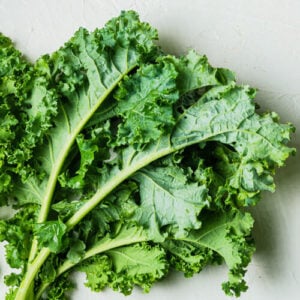
- Spinach: #1 on the 2026 list for the second consecutive year
- Kale: #2 on the 2026 list, up from #3 in 2025
- Strawberries: #3 on the 2026 list
- Arugula: in the related leafy greens category
When you grow these crops in a Hybriponic system, the pesticide and PFAS question does not arise. The plants grow in a closed indoor environment, in a rockwool-based growing medium with no soil, no external pest exposure, and no pesticide inputs of any kind. What Kelby AI manages is water delivery, light scheduling, and plant health. Not pesticide application.
The 2026 PFAS addition makes this more relevant
The new PFAS data in the 2026 guide adds a dimension beyond conventional pesticides. PFAS chemicals are detected not just from direct pesticide application but from soil and water contamination, atmospheric deposition, and agricultural inputs that have accumulated in farmland over decades. They are, by definition, persistent: they do not break down and they accumulate.
Growing spinach, kale, and strawberries hydroponically, in a controlled indoor environment using municipal water and clean growing medium, eliminates both the conventional pesticide vector and the soil/field accumulation vector for PFAS exposure in those specific crops.
The certainty argument
The Dirty Dozen debate is partly about numbers, but it is also about uncertainty. A household eating conventional spinach every day cannot easily know what pesticides, at what concentrations, are on that particular batch. The risk assessments suggesting conventional produce is safe rely on average population consumption and average residue levels; individual households with high daily spinach or kale consumption may sit well above those averages.
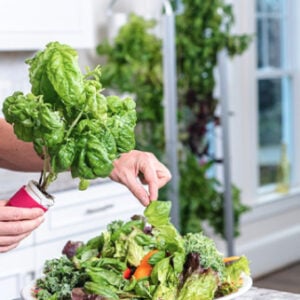
Home growing does not require you to resolve the risk debate. It eliminates the uncertainty for the specific crops you grow. Growing spinach in a Hybriponic system means you know exactly what went into the growing environment, because it is in your kitchen. That clarity has value regardless of how you read the toxicology.
Freshness compounds the case
The pesticide question and the freshness question both point in the same direction for home growers. Spinach and kale lose nutritional content progressively after harvest. Vitamins, antioxidants, and phytonutrients degrade through the supply chain, through refrigeration, and through storage in your kitchen before consumption.
Produce grown at home and eaten the same day retains the full nutritional profile it had at peak ripeness. For the two most pesticide-contaminated crops in the country (spinach and kale), growing them at home simultaneously maximises nutrition and eliminates pesticide exposure. See the why eating at harvest is healthier post for the research on nutritional decline post-harvest.
| Grow the 2026 Dirty Dozen crops pesticide-free at home |
| Spinach (#1), kale (#2), strawberries (#3), arugula, and more: grow the most pesticide-heavy crops in the US in a Hybriponic system with no pesticide inputs, no supply chain, and complete transparency about what went into your food. |
Further reading: EWG 2026 Shopper’s Guide to Pesticides in Produce; Jacobs et al. (2024): Screening-level risk assessment of EWG’s Dirty Dozen pesticide exposures; USDA Pesticide Data Program: annual testing data; Rickman et al. (2007): Nutritional comparison of fresh and stored produce
Frequently asked questions
What is the 2026 Dirty Dozen list?
EWG’s 2026 Dirty Dozen, published this week, lists the 12 most pesticide-contaminated conventionally grown fruits and vegetables based on USDA testing of over 54,000 samples. The 2026 list in order: spinach, kale/collard/mustard greens, strawberries, grapes, nectarines, peaches, cherries, apples, blackberries, pears, potatoes, and blueberries. For the first time, the 2026 guide includes PFAS pesticide data.
What changed between the 2025 and 2026 Dirty Dozen?
The 2026 list adds PFAS pesticide data for the first time, detecting PFAS on 63% of all Dirty Dozen produce samples. In terms of rankings: spinach holds #1, kale moves from #3 to #2, strawberries moves from #2 to #3. The overall list composition remains largely consistent.
What are PFAS pesticides?
PFAS (per- and polyfluoroalkyl substances) are synthetic chemicals that persist in the environment and in the body. Some pesticides contain PFAS compounds. The 2026 EWG guide is the first to report PFAS pesticide residue data alongside conventional pesticide residues on Dirty Dozen produce.
Is produce on the 2026 Dirty Dozen dangerous to eat?
Independent risk assessments applying EPA health-based guidance values consistently find that consumer exposure to pesticides from Dirty Dozen produce at normal dietary intake levels is well below safety thresholds. EWG itself states that the benefits of produce consumption outweigh the risks of pesticide exposure. The guide is a preference tool, not a list of foods to avoid.
Can I grow the Dirty Dozen crops at home without pesticides?
Yes. Gardyn’s Hybriponic system grows spinach, kale, strawberries, arugula, and other crops in a closed indoor environment with no pesticide inputs. The controlled growing environment eliminates the pest and disease pressures that make pesticides necessary in field agriculture.
Why are spinach and kale consistently at the top of the Dirty Dozen?
Leafy greens with large surface areas are more prone to pesticide residue accumulation than thick-skinned fruits. Spinach and kale are also grown with relatively intensive pesticide application in conventional agriculture. Their nutritional density and frequent use in salads and smoothies make them among the most important crops to consider growing at home.
Does growing food at home make a nutritional difference beyond pesticides?
Yes. Spinach and kale both lose vitamins and antioxidants progressively after harvest. Produce eaten on the day of harvest retains its full nutritional profile. Grocery store greens may have spent several days in the supply chain. See why eating at harvest is healthier for the research.