Cookies help us deliver the best experience on our website. By clicking Accept you are agreeing to the placement and use of cookies as described in our privacy policy.


Chronic low-grade inflammation is implicated in virtually every major non-communicable disease: cardiovascular disease, type 2 diabetes, Alzheimer’s disease, certain cancers, and autoimmune conditions. Diet is one of the most modifiable drivers of systemic inflammation — and within diet, culinary herbs represent one of the most concentrated and underutilised sources of anti-inflammatory compounds available.
The mechanisms by which specific herb compounds modulate inflammatory pathways are well characterised in cell studies and increasingly supported by human clinical research. Growing herbs at home changes the equation because the volatile and oxidation-sensitive compounds responsible for many of these effects are most potent in freshly harvested leaves.
Key takeaways
- Rosmarinic acid in basil and oregano inhibits both COX-1 and COX-2 enzymes (prostaglandin pathway) and lipoxygenase (leukotriene pathway) — addressing multiple inflammatory mechanisms simultaneously.
- Fresh basil contains meaningfully higher rosmarinic acid than dried; studies document losses of 30 to 80% during standard herb drying depending on method and temperature.
- Oregano has the highest antioxidant content of any commonly used culinary herb by ORAC value, and higher rosmarinic acid concentrations than basil.
- Carnosic acid and carnosol in rosemary strongly inhibit NF-κB activation and reduce TNF-α and IL-6 production in human cell studies.
- Thymol and carvacrol in thyme have demonstrated COX-2 inhibitory activity — the same enzyme targeted by NSAIDs like ibuprofen — in laboratory studies.
- Growing herbs at home and using them daily in tablespoon-sized rather than pinch-sized quantities is what makes the difference; anti-inflammatory dietary effects are cumulative and require consistency.
What inflammation is and how diet affects it
Key inflammatory pathways that herbs modulate
The most studied anti-inflammatory targets for dietary compounds include NF-κB — the master regulator of inflammatory gene expression — COX-1 and COX-2 enzymes, which produce prostaglandins from arachidonic acid; lipoxygenase enzymes, which produce leukotrienes; and cytokines including TNF-α, IL-6, and IL-1β. Multiple herb compounds have demonstrated activity at one or more of these targets.
| Important context
The anti-inflammatory research on culinary herbs is compelling but most human trials use supplemental concentrations far higher than typical dietary intake. Culinary use of fresh herbs provides meaningful but not therapeutic doses. Growing and using fresh herbs daily provides consistent low-dose anti-inflammatory support — not acute treatment of inflammatory conditions. |
The most evidence-supported anti-inflammatory herbs for home growing
Basil: rosmarinic acid and eugenol
Sweet basil contains rosmarinic acid, a polyphenol with demonstrated inhibition of both COX enzymes and lipoxygenase, effectively addressing both prostaglandin and leukotriene pathways. It also contains eugenol, which inhibits COX-2 specifically (the same enzyme targeted by NSAIDs like ibuprofen), and flavonoids including quercetin and kaempferol with NF-κB inhibitory activity.
Fresh basil contains meaningfully higher rosmarinic acid than dried basil. Studies of rosmarinic acid stability show significant losses at temperatures used for herb drying (30 to 80% depending on method). Growing and harvesting fresh basil daily provides the compound in its full original concentration.
Grow basil at home. See also types of basil — Genovese basil has the highest rosmarinic acid content.
Rosemary: carnosic acid and carnosol
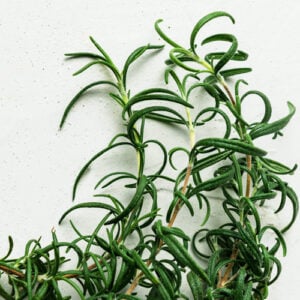 Rosemary is among the most potent antioxidant herbs by ORAC value. Its primary anti-inflammatory compounds — carnosic acid and carnosol — strongly inhibit NF-κB activation and reduce TNF-α and IL-6 production in human cell studies. Using fresh rosemary in cooking, particularly added near the end of cooking to preserve volatile compounds, provides a more complete phytochemical profile than dried.
Oregano: the highest antioxidant herb
Oregano has the highest antioxidant content of any commonly used culinary herb, measured by ORAC value significantly exceeding even basil and rosemary. Its primary anti-inflammatory compounds are rosmarinic acid (in higher concentrations than basil), thymol, and carvacrol. A 2007 review in the Journal of Food Science documented carvacrol’s inhibition of NF-κB and reduction of COX-2 activity in cell studies.
Thyme: thymol and luteolin
Thyme contains thymol, carvacrol, and the flavonoid luteolin. Luteolin has demonstrated inhibition of NF-κB and STAT3 inflammatory signalling pathways in multiple cell studies. Fresh thyme preserves these compounds far better than dried, where thymol losses during drying can exceed 50 percent.
Sage: ursolic acid and salvianolic acids
 Sage contains ursolic acid, a pentacyclic triterpenoid with anti-inflammatory activity demonstrated in multiple in vitro and animal studies including inhibition of COX enzymes and reduction of pro-inflammatory cytokines. It has been studied in the context of neuroinflammation and cognitive function.
Cilantro: quercetin and linalool
Cilantro contains quercetin, kaempferol, and linalool — a terpene compound with demonstrated anti-inflammatory activity. Fresh cilantro is significantly more potent than dried for linalool specifically, as this volatile compound dissipates rapidly with heat and extended storage.
Grow cilantro at home and how to grow cilantro indoors.
Building anti-inflammatory herb use into daily cooking
- Add a large handful of fresh basil to salads, pasta, or eggs daily for rosmarinic acid and eugenol
- Use fresh oregano in dressings: chop one to two tablespoons into olive oil and lemon for a phytochemical-dense dressing
- Add fresh rosemary to roasted vegetables or olive oil dips at quantities higher than typical dried herb use
- Steep fresh thyme in hot water for five minutes to extract flavonoids without degrading them with excess heat
- Use fresh cilantro as a condiment rather than a garnish — full sprigs rather than a few leaves add meaningful linalool and quercetin
Five ways to use fresh herbs and grow your own herbal tea.
Frequently asked questions
Can herbs replace anti-inflammatory medications?
No. The anti-inflammatory activity of culinary herbs at dietary levels is meaningful for supporting overall inflammatory status but is not clinically equivalent to medications for treating diagnosed inflammatory conditions. Consult your physician before changing any medication based on dietary changes.
Which herb has the strongest anti-inflammatory evidence?
Rosemary and oregano have the strongest antioxidant profiles by ORAC value. Basil has the most studied rosmarinic acid content. All herbs in this article have multiple published studies supporting anti-inflammatory mechanisms. Use all of them regularly rather than selecting one.
Does cooking destroy anti-inflammatory compounds in herbs?
High heat and prolonged cooking reduce volatile compounds and some polyphenols significantly. Adding fresh herbs near the end of cooking, or using them raw in dressings and salads, preserves more of their phytochemical content.