Cookies help us deliver the best experience on our website. By clicking Accept you are agreeing to the placement and use of cookies as described in our privacy policy.


Stress eating is one of the most common and least effectively addressed eating patterns in nutrition counselling. It is not a willpower problem, a character flaw, or a knowledge deficit. It is a well-characterized psychological mechanism that responds poorly to restriction-based interventions and much better to behavioral and environmental change.
Spring is a natural reset point. The shift in light, temperature, and energy opens a window for habit change that does not exist to the same degree in the middle of winter or summer. This article covers what stress eating actually is, why it intensifies over winter, and why home growing specifically, not just healthy eating generally, creates the kind of environmental and behavioral shift that makes a sustainable difference.
Key takeaways
- Cortisol, the stress hormone, increases appetite specifically for high-calorie, high-fat, and high-sugar foods and reduces the
 effectiveness of leptin (the satiety hormone). This is a biological mechanism, not a psychological weakness.
 - The most evidence-supported interventions for habitual stress eating involve changing the environment around food choices, not the knowledge or motivation of the person, proximity to food is one of the strongest predictors of consumption.
- Growing food at home creates a novel behavioral loop, the harvest ritual, that can compete with the established stress-eating loop by providing a sensory, purposeful, identity-affirming alternative.
- Agency and control are significant drivers of stress eating, growing your own food is one of the most concrete expressions of agency over a fundamental life need, which the Gardyn persona research identifies as a top motivation for home growing.
- Magnesium from spinach and Swiss chard directly moderates the cortisol stress response, chronic cortisol depletes magnesium, and low magnesium worsens the HPA axis response, creating a cycle that diet can help break.
- Lemon balm has multiple randomised controlled trials demonstrating reductions in anxiety and salivary cortisol, making it one of the few culinary herbs with strong human evidence for mood and stress support.
What stress eating actually is
The cortisol-appetite connection
When the body experiences stress, cortisol rises more slowly than adrenaline and stays elevated longer, and unlike adrenaline (which suppresses appetite), cortisol increases appetite specifically for high-calorie, high-fat, and high-sugar foods. This is a biological mechanism, not a psychological weakness. Cortisol also promotes fat storage in the abdominal region and reduces the effectiveness of leptin, the satiety hormone, making it harder to recognize fullness.
Why willpower-based approaches fail
Attempting to eliminate stress-eating foods through restriction typically produces the rebound effect: the restricted food becomes more psychologically salient, cravings intensify, and when restriction eventually fails, the resulting consumption is often larger than it would have been without the restriction period. This is not a failure of motivation, it is a predictable outcome of how the brain’s reward circuitry responds to scarcity. Research on environmental redesign as a behavior change strategy consistently outperforms knowledge-based interventions for habitual eating behaviors.
How home growing changes the food environment
Proximity and immediacy
 One of the most consistent findings in behavioral nutrition research is that proximity to food increases consumption. Home growing applies this principle to healthy food: when fresh greens are three steps away in your kitchen, the barrier to reaching for them is equivalent to the barrier to reaching for a snack food on the counter. A Gardyn system in your kitchen means a harvest is available in under a minute.
The harvest as a pattern interrupt
Habitual stress eating is triggered by cues, typically emotional states, environmental contexts (sitting at a desk, watching television), and physiological signals (mild hunger, low energy). The act of harvesting from a Gardyn system introduces a novel behavioral loop that can compete with the established stress-eating loop. Walking to your garden, selecting a leaf, tasting it directly from the plant, this is a sensory and behavioral experience sufficiently different from opening a bag of crisps to create a genuine pattern interrupt.
Agency and control
A significant driver of stress eating is the psychological need for control during periods when other aspects of life feel out of control. Growing your own food is one of the most concrete expressions of agency over a fundamental life need. Benefits of horticultural therapy covers the psychological research on why tending plants specifically produces measurable wellbeing effects.
The nutritional side: plants that counter stress physiology
Magnesium for cortisol regulation
Chronic stress depletes magnesium, and low magnesium worsens the cortisol stress response, creating a cycle. Leafy greens, particularly spinach and Swiss chard, are among the best dietary magnesium sources. Eating them consistently can support the physiological side of stress management alongside the behavioral interventions.
B vitamins for nervous system support
B vitamins, including folate, B6, and B12, are required for the synthesis of serotonin, dopamine, and GABA. Folate from fresh leafy greens is the most dietary-accessible of these. Growing and harvesting leafy greens at peak freshness maximizes folate delivery, as it is one of the most storage-sensitive vitamins. See why eating at harvest is healthier for the full picture.
Lemon balm: anxiolytic volatile compounds
Lemon balm contains rosmarinic acid and compounds that modulate GABA receptors. A randomised controlled trial in Nutrients found lemon balm extract significantly reduced anxiety, stress, and insomnia scores after 15 days. Growing and using fresh lemon balm daily provides both the behavioral ritual and the anxiolytic compound.
Grow lemon balm at home and how to grow mint indoors.
A spring behavioral reset plan
Week one: identify your triggers
Before changing what you eat, observe when you eat under stress. Keep a simple note for one week: what time, what emotional state, what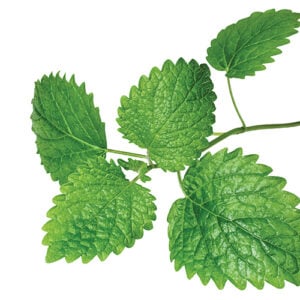 food. Most people find two or three consistent trigger patterns rather than continuous stress eating. Identifying them is the foundation for environmental redesign.
Week two: place fresh food at the trigger point
If you stress eat at your desk in the afternoon, place your Gardyn in your office or put a small bowl of just-harvested greens on your desk before your high-stress period. Do not remove the stress-eating food. Simply introduce a closer, more accessible alternative.
Week three: build the harvest habit
Establish a daily harvest ritual at a consistent time, ideally before your highest-stress period of the day. The act of harvesting creates a moment of mindfulness that interrupts the automatic quality of stress eating loops. Five minutes of harvesting before the afternoon stress window changes what is salient and accessible at the moment of highest risk.
How Gardyn makes life less stressful covers community experiences with this kind of daily ritual.
Frequently asked questions
Is stress eating a psychological problem or a nutritional one?
Both. The trigger is psychological (cortisol and emotional cues), but the physiological consequence is nutritional (caloric surplus, micronutrient displacement, blood sugar dysregulation). The most effective interventions address both layers.
Can growing plants really reduce stress?
Yes. The research on horticultural therapy demonstrates measurable reductions in cortisol, anxiety, and self-reported stress from tending plants. The effect is distinct from simply being around greenery, though that also has documented benefits.
Will I actually eat fresh greens instead of snack foods when stressed?
Not necessarily at first, and that is fine. The goal is gradual environmental redesign. Making fresh food the easiest thing to reach for, rather than requiring willpower to choose it, changes behavior over weeks rather than requiring immediate substitution.