Cookies help us deliver the best experience on our website. By clicking Accept you are agreeing to the placement and use of cookies as described in our privacy policy.


Every so often a story comes across my desk that captures exactly why we love putting Gardyn systems in schools. This is one of them. In Howard County, Maryland, students spent the school year watching seeds turn into vegetables, herbs, and flowers right in their classrooms, then tasting the results. No backyard, no growing season to wait for, no green thumb required. Just curiosity, water, and a front-row seat to how food actually grows.
Here is what happened, why it works so well for young learners, and how you can bring the same experience to your own classroom.
Key takeaways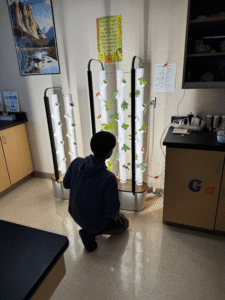
- The Howard County Food Council installed Gardyn systems in seven county schools, where students grew fresh vegetables, herbs, and flowers through hands-on instruction during the 2025 to 2026 school year.
- Teachers reported that students were more curious, more excited, and more willing to try vegetables they had never tasted before.
- Indoor growing connects naturally to science, nutrition, and social-emotional learning, and it fits into a normal school day with very little upkeep.
- The program is set to expand to four high schools for the 2026 to 2027 year, folded into Life Skills programming.
- Any school can start smaller, and there are grant paths that help cover the cost.
What happened in Howard County
The Howard County Food Council, a partnership between the Howard County Health Department and University of Maryland Extension, placed Gardyn systems in seven schools across the county. Students grew fresh produce through hands-on instruction, then shared the harvest for tasting and experimenting as they learned more about the food they had raised themselves. You can see photos from the classrooms in the county’s public photo album.
County leaders framed the program as a way to connect classroom lessons to real life. Dr. Maura Rossman, the county’s Health Officer, described growing your own food as a strong way to engage students and show them how agriculture shapes everyday health. County Executive Calvin Ball noted that the systems do more than grow produce; they cultivate curiosity and teach students about nutrition, science, and sustainability. Superintendent of Schools William J. Barnes pointed out that hands-on learning with a real-world outcome tends to stay with a student for a lifetime. Nathan Glenn, who helps oversee the initiative with University of Maryland Extension, added that the systems turn classrooms into hands-on environments where students explore science, technology, and agriculture at once. You can read the county’s full announcement here.
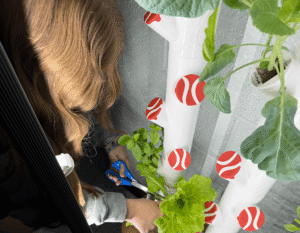 When students grow their own food, the lesson stops being abstract. They are not reading about photosynthesis; they are watching it happen on their windowsill and eating the result.
Why growing food in the classroom works so well
We hear the same thing from teachers again and again, and Howard County’s first-year feedback echoed it: students get genuinely excited, and that excitement opens doors. Kids who might push a new vegetable to the edge of their tray will happily taste something they planted, tended, and harvested with their own hands.
A single system quietly touches several parts of the curriculum:
- Science and STEM. Germination, plant life cycles, water and nutrients, light, and measurement all become observable, day-by-day experiments. If you want a starting point, we put together nine easy ways to build agriculture into a STEM curriculum.
- Nutrition and food literacy. Tasting fresh greens changes how students think about what is on their plate. It is the classic plant-to-plate lesson, made real.
- Social-emotional learning. Caring for a living thing builds patience, responsibility, and pride. We wrote more about how a Gardyn system supports social-emotional learning if you want to dig in.
- Leadership and teamwork. Students take ownership of the garden, divide up tasks, and teach one another, which is exactly the kind of therapeutic, confidence-building experience Howard County teachers highlighted.
How the systems fit into a school day
The reason this works in a busy classroom is that the technology carries the heavy lifting. Gardyn systems use our Hybriponic™ technology to grow plants in water rather than soil, so roots absorb nutrients directly. Plants grow faster, the system uses far less water than a traditional garden, and food can grow indoors all year long, snow days included.
Kelby, the built-in AI assistant, keeps an eye on things between lessons and sends reminders when it is time to refill the tank or check on the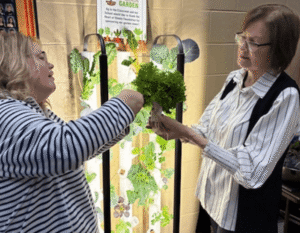 plants. That means a teacher does not need a background in horticulture to run a thriving classroom garden. The learning stays front and center, and the upkeep stays in the background.
For a classroom, the smaller footprint of Gardyn Studio Gen2, which grows up to sixteen plants, often fits neatly on a counter or shelf, while Gardyn Home, with room for thirty plants, suits larger spaces like a common area, library, or cafeteria. A Microgreens Kit is a lovely low-cost way to run a fast, satisfying grow cycle when you want results in a couple of weeks. You can see how all of it works on our how it works page.
What comes next in Howard County
The first phase prioritized community schools, and the results were strong enough that the county is expanding. For the 2026 to 2027 school year, the program is set to reach four high schools, where it will be built into Life Skills programming alongside University of Maryland Extension’s 4-H Youth Development team, with additional learning support for every participating school. It is a great example of how a small pilot can grow into something district-wide once students and teachers experience it firsthand.
| Thinking about a classroom garden of your own?
You do not have to start with seven systems. Many schools begin with a single unit in one classroom and grow from there. If budget is the hurdle, funding is often more available than teachers expect. Start with our guide to securing a grant for Gardyn in your classroom, and consider timing a launch around National Farm to School Month in October, when interest and support tend to peak. |
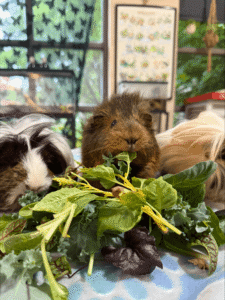 Bring the harvest to your students
Programs like Howard County’s show what is possible when growing becomes part of the school day. Fresh food, real science, and students who are proud of what they made. If you would like to explore what a Gardyn program could look like at your school, we would love to help you get started.
| Grow with your students, all year long
Explore Gardyn Studio Gen2 for a single classroom or Gardyn Home for a shared space, and see how easy year-round growing can be. Curious about the nutrition angle for students? Visit our nutrition page to learn more. |
Frequently Asked Questions
What is hydroponic gardening in schools?
It is a way for students to grow plants in nutrient-rich water instead of soil, right inside the classroom. Gardyn systems use our Hybriponic™ technology, so students can grow fresh vegetables, herbs, and flowers year-round while learning the science behind how plants grow.
Do teachers or students need gardening experience?
No. The systems are designed to be nearly self-managing. Kelby, the built-in assistant, monitors the plants and sends simple reminders, so a teacher can run a successful classroom garden without any horticulture background.
How much upkeep does a classroom system need?
Very little. Most of the maintenance comes down to occasionally refilling the water tank and doing a light cleaning, both of which make excellent shared student jobs and reinforce responsibility.
What can students grow?
A wide variety of leafy greens, herbs, vegetables, and flowers. Fast-growing greens and microgreens are especially rewarding for younger students because visible results arrive quickly, which keeps curiosity high.
How do schools pay for a Gardyn program?
Many schools use grants, education funding, or community partnerships to cover the cost. Our classroom grant guide walks through where to look and how to make a strong case.