Cookies help us deliver the best experience on our website. By clicking Accept you are agreeing to the placement and use of cookies as described in our privacy policy.


The appeal of a garden that takes care of itself is real and legitimate: most people who want fresh herbs and greens in their kitchen don’t want a second job managing them. This guide maps the full spectrum of automatic and self-watering indoor growing options, from basic wicking planters to AI-monitored hydroponic systems, so you can choose the level of automation that matches what you actually want.
Key takeaways
- Automatic indoor gardens range from simple self-watering planters (extend watering intervals) to fully automated hydroponic systems (handle watering, lighting, and monitoring).
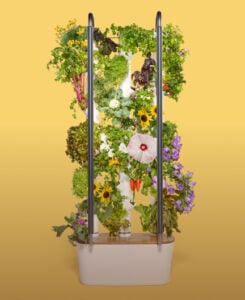
- Self-watering planters solve one problem; automated systems solve three : the difference matters for actually productive food growing.
- The Gardyn system uses a closed-loop automated pump, integrated LED lighting on a programmed schedule, and Kelby AI monitoring : the three variables that most commonly cause indoor food gardens to fail.
- Automation quality matters more than brand marketing: look for sealed water delivery, grow-stage-specific lighting, and active plant monitoring, not just a reservoir.
- Weekly maintenance for a fully automated system like Gardyn averages under 10 minutes, primarily reservoir refill and harvesting.
The spectrum of automatic indoor gardening
Not all “automatic” or “self-watering” systems are equivalent. There’s a meaningful difference between a planter that wicks water from a reservoir and a system that manages every variable a plant needs. Understanding the spectrum helps you match the right solution to your situation.
| System type | What it automates | What you still manage | Best for |
| Self-watering planter / wicking pot | Water delivery between refills | Refilling, light, nutrients, monitoring | Single houseplants; basic herbs |
| Drip timer kit (DIY) | Watering schedule via timer | Calibration, light, nutrients, monitoring | Small setups; DIY-inclined growers |
| Small pod systems (3–9 pods) | Watering + LED lighting | Monitoring, limited variety | Single herb focus; starter systems |
| Full smart garden system (Gardyn) | Watering + lighting + AI monitoring | Weekly reservoir refill; harvesting | Full herb + greens garden; serious home growers |
How self-watering planters work
A self-watering planter : also called a wicking planter or reservoir planter, has two chambers: a growing chamber above and a water reservoir below. A wick or perforated divider draws water upward by capillary action as the soil dries out, maintaining consistent moisture without daily watering.
This is genuinely useful. It extends the interval between waterings from every 1–2 days to every 7–14 days depending on plant type and pot size. For someone who regularly forgets to water, this is the difference between alive and dead.
The limitation: it only solves watering. Light is still your problem. Nutrients (if not built into the growing medium) are still your problem. And if the reservoir runs dry, which it will : the plant stresses or dies just as it would without the reservoir. A self-watering planter is a buffer, not automation.
What full automation actually requires
For a food-producing indoor garden to be genuinely low-maintenance, three variables need to be consistently managed, and all three need to be right simultaneously:
1. Watering, precise, consistent delivery
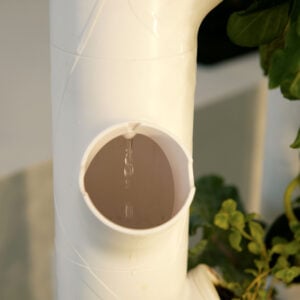 Plants need water at the right quantity and frequency, not just “some water eventually.” A reservoir with a wicking system helps but doesn’t provide the active, measured delivery that hydroponic growing requires. Gardyn’s Hybriponic™ pump system circulates nutrient-enriched water on a precise timer to every pod simultaneously : not passive wicking, but active circulation calibrated for hydroponic growth rates.
2. Lighting : the right spectrum and duration
This is where most home herb gardens fail silently. Most kitchens don’t provide 6–8 hours of direct, high-intensity light that herbs need for productive growth. Plants survive in low light; they don’t thrive or produce well. An automated growing system with an integrated full-spectrum LED removes this variable entirely : the light runs on a schedule, at the right intensity and spectrum, regardless of which way your windows face or what season it is.
3. Monitoring, knowing when something is wrong
Traditional growing puts the diagnostic burden on you: reading leaves, checking soil moisture, identifying early pest or nutrient signs before they become plant-killing problems. Kelby AI in the Gardyn app monitors plant health continuously using camera data and sensor readings. When something needs attention, you’re notified. When everything is healthy, which is most of the time, you don’t need to inspect anything.
Smart garden features worth looking for
If you’re evaluating smart indoor garden systems, these are the features that actually affect growing outcomes rather than just appearing impressive in marketing:
- Sealed water delivery system: Open-top reservoirs that require precise manual pouring increase the chance of overflow and inconsistent delivery. A sealed system with a defined reservoir opening is more reliable and lower mess.
- Growth-stage lighting: The best light schedule for seedlings differs from mature plants. Systems that automatically adjust lighting duration or intensity based on plant growth stage outperform simple on/off timers.
- Active plant monitoring vs passive: A system that alerts you when something needs attention is fundamentally different from one where you have to notice problems yourself. Active AI monitoring changes the maintenance burden.
- Pre-seeded growing pods: Starting from scratch with seeds adds a germination variable and waiting period. Pre-seeded pods, like Gardyn’s yCubes, remove this step entirely.
- Variety depth: A system with 3 pods can grow 3 plant types. A system with 16 or 30 slots can grow a full kitchen herb garden plus salad greens simultaneously. Capacity determines how useful the system is in daily cooking.
- Vacation or away mode: Any system that requires your presence every few days is not truly low-maintenance. A built-in mode that adjusts the system for non-harvesting periods is essential for travelers.
The Gardyn system: what it automates and what it doesn’t
Being specific about what the Gardyn Studio and Gardyn Home actually automate, and what remains your responsibility:
Fully automated
- Water circulation to all pods on a programmed pump cycle
- Full-spectrum LED lighting on a schedule calibrated to plant growth stage
- Plant health monitoring via Kelby AI, continuous, with app notifications when action is needed
- Vacation mode operation when you’re away
Your weekly tasks
- Reservoir refill: ~2 gallons of water, once per week. Kelby reminds you when the level is low. 60–90 seconds.
- Harvesting: 2–3 minutes per plant, 2–3 times per week when plants are in active production. This isn’t maintenance, it’s cooking.
- yCube replacement: When a plant completes its cycle (Kelby tells you), swapping in a new yCube takes about 60 seconds.
|
Microgreens: the truly automatic short-cycle option
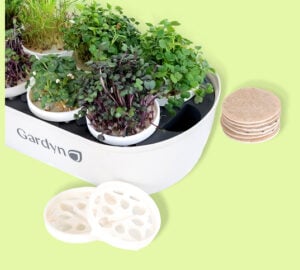
For growers who want the fastest-possible fresh produce with the absolute minimum ongoing management,
Gardyn microgreens offer a different profile:seed pads in the Sprout Nursery tray, natural window light, water check every couple of days, harvest at day 7–10. No app, no LED management, no ongoing commitment. Plant, water occasionally, harvest, replant.
Microgreens are a complement to a full Gardyn system, not a replacement, they’re a one-harvest crop that’s replanted each time rather than a continuous producer. But for someone wanting the lowest-possible-friction introduction to indoor growing, the Microgreens Complete Kit is a genuine entry point.
Which system is right for you
| If you want… | Consider… |
| One or two herbs with minimal fuss | Self-watering planter, extend watering intervals, manage light yourself |
| A starter system before committing fully | Microgreens Complete Kit, 7-day harvest cycle, natural light, low cost |
| 16 plants, full herb + greens garden, minimal daily involvement | Gardyn Studio, 1.4 sq ft, fully automated, Kelby AI |
| 30 plants, maximum variety, family-scale production | Gardyn Home, 2 sq ft, same automation, larger capacity |
| Maximum speed before deciding on a full system | Microgreens first, then Gardyn : the two work together |
See also: compare Gardyn systems, how it works, and automated grow system explained.
|
|
Frequently asked questions
What is the best automatic indoor herb garden?
For a full herb and greens garden with genuine automation, the Gardyn Studio (16 plants) and Gardyn Home (30 plants) lead the category, automated watering, integrated LED lighting on a growth-stage schedule, and Kelby AI monitoring that alerts you when anything needs attention. For a smaller commitment, small pod systems (3–9 pods) offer automated lighting and basic watering at lower cost but limited capacity.
Do self-watering planters actually work?
Yes, for their stated purpose: extending the interval between manual waterings from every few days to every 1–2 weeks, depending on plant and pot size. They’re a meaningful improvement over standard pots for people who forget to water. They don’t solve lighting, nutrients, or monitoring, just watering frequency. For a decorative houseplant, that’s often sufficient. For a productive food garden, the other variables matter as much as water.
How does Kelby AI work?
Kelby is the AI assistant built into the Gardyn app. It monitors plant health using camera data and system sensors, tracking indicators like growth rate, color changes, and water level. When something needs attention, low water, a plant ready to harvest, a pod that may need replacement, Kelby sends a notification through the app. Between alerts, Kelby’s status shows green: everything is healthy, no action needed.
Can I control a Gardyn system from my phone?
Yes : the Kelby app provides full system visibility and control: plant status, water level, lighting schedule, and system settings including vacation mode. You can also access Gardyn support directly through the app. The app is available for iOS and Android.
How long does a Gardyn yCube last?
Most herbs and greens produce actively for 6–10 weeks from planting before beginning to decline. Longer-lived varieties like rosemary, thyme, and sage can produce for several months. Kelby monitors production cycles and notifies you when a plant is ready to be replaced with a new yCube.