Cookies help us deliver the best experience on our website. By clicking Accept you are agreeing to the placement and use of cookies as described in our privacy policy.


If you haven’t heard of America’s Potluck, you’re not alone. Most Americans haven’t. It is, however, a real federally endorsed event, scheduled for Sunday, July 5th, 2026, and it’s the official closing day of the Semiquincentennial week marking the 250th anniversary of the Declaration of Independence. The federal America250 commission and the state of Utah’s commission have organized it as a single coordinated nationwide gathering: tens of thousands of community potlucks, all held on the same day, with a stated goal of 25,000 events nationwide.
This article is the complete explainer: what America’s Potluck is, why July 5th specifically, who’s behind it, how to register or find a gathering, what the conversation looks like, and a full make-ahead menu for either hosting or attending. By the end, you’ll know more about America’s Potluck than most of your neighbors, including the ones planning to host one.
Key takeaways
- America’s Potluck is a real federally endorsed event for Sunday, July 5th, 2026, organized by the America250 Utah Commission with more than 70 national partners including the American Legion and Interfaith America.
- It’s the official closing day of the Semi-quincentennial week: Times Square ball drop July 3rd, America’s Block Party July 4th, America’s Potluck July 5th. Together they form “America’s Day of Reflection.”
- The premise: 80 percent of Americans believe the country is greatly divided, but 66 percent believe we can learn from people who disagree. America’s Potluck creates the structured opportunity to do that, around a shared meal.
- Anyone can host. Sign up at the official site, gather neighbors, bring food, follow the conversation toolkit. There is no fee, no permit required for private gatherings, and no political litmus test.
- The right menu is make-ahead, leftover-friendly, and travels well. Most households will have Fourth-of-July leftovers to repurpose into Sunday-dinner-style dishes that hold up at room temperature within USDA food-safety guidelines.
What is America’s Potluck?
America’s Potluck is a coordinated nationwide event scheduled for Sunday, July 5th, 2026. The premise is simple: on that single day, communities across all 50 states and Puerto Rico will host potluck meals, with the federal America250 commission tracking gatherings on an interactive map and providing a free hosting toolkit. The goal, stated publicly by organizers, is 25,000 potlucks nationwide.
The event isn’t a party. It’s deliberately framed as part of “America’s Day of Reflection,” the day after the celebratory fireworks-and-grilling of America’s Block Party on July 4th. The mood is quieter. The conversation is the point. Food is the medium that makes the conversation possible.
Three official touchpoints define the Semiquincentennial week:
- July 3rd, 2026: a special Times Square ball drop at 11:59 PM ET, the first non-New-Year’s-Eve ball drop in the tradition’s 120-year history, marking the start of the 250th Independence Day.
- July 4th, 2026: America’s Block Party, the centerpiece celebration, with synchronized neighborhood gatherings across the country.
- July 5th, 2026: America’s Potluck, the closing day, with structured community meals focused on conversation across difference.
Why July 5th, not July 4th?
The Fourth of July is already taken. America’s Block Party is the federal celebration on the actual anniversary, and most American households already have a Fourth of July tradition (grilling, fireworks, family gatherings). Adding another major event to that day would have asked too much.
July 5th, 2026 falls on a Sunday, which is the deliberate hook. The official framing borrows from the American tradition of Sunday dinner, which historically has been the slower, longer meal of the week, the one where families and neighbors actually talk. Organizers wrote it this way on the official Utah commission site: “The tradition of Sunday dinner invites us to slow down, serve others, and connect with one another.”
There’s also a practical food-safety logic. By July 5th, most households have leftovers from the Fourth of July cookout. America’s Potluck gives those leftovers a destination. Pulled pork becomes sliders. Grilled chicken becomes a salad. Smoked brisket becomes tacos. The Sunday potluck is, in part, a solution to the inventory problem most July 4th hosts wake up with.
Who organized America’s Potluck?
The lead organizer is the America250 Utah Commission, the state-level body responsible for Utah’s Semiquincentennial programming. Utah Governor Spencer Cox is the central figure. The initiative grew out of his “Disagree Better” civic-engagement campaign, which he led as chair of the National Governors Association in 2023 and 2024.
More than 70 national partners are involved, including:
- The American Legion, which has issued a National Executive Committee resolution encouraging all Legion posts to coordinate with their state America250 commissions
- Interfaith America, the Eboo Patel-led nonprofit that produced the official America’s Potluck Toolkit alongside the Utah commission
- State commissions in Connecticut, Wyoming, New Jersey, and others, which have officially endorsed and promoted the event
- Macey’s grocery (representing 450 independent grocers across nine western states), which is publishing official America’s Potluck recipes
- Community Plate, a Maine-based nonprofit that hosts story-and-meal gatherings
The event is nonpartisan and ecumenical by design. The official framing avoids political content and focuses on community, civic dialogue, and connection across difference.
 Why the 250th anniversary needs a potluck
The premise has data behind it. The Interfaith America toolkit cites More in Common research showing that 80 percent of American adults believe the country is greatly divided. But the same research found that 66 percent of Americans believe they can learn from people with differing viewpoints, and 70 percent believe they have a responsibility to do so.
The gap isn’t willingness. It’s opportunity. The research explicitly identified “the most cited barrier to connecting across differences” as a lack of opportunity to do it. America’s Potluck is designed as a national supply of that opportunity, delivered on a single day, in 25,000 neighborhoods at once.
Eboo Patel, the president of Interfaith America who has been a central voice on the initiative, has used the potluck specifically as a model for American pluralism: everyone contributes something different, everyone belongs at the table, and the diversity of dishes mirrors the diversity of people.
“Potlucks mirror what’s great about America: everyone contributes something unique, and the diversity of dishes mirrors the diversity of people. It’s a low-pressure, welcoming setting where differences become strengths.” , Interfaith America, America’s Potluck Toolkit
How to participate in America’s Potluck
There are three ways to take part: host one, attend a registered public one, or organize a private gathering without registering.
Option 1: Host an official America’s Potluck
Sign up at the official America250 Utah site (america250.utah.gov/americaspotluck). Hosts receive a free toolkit with conversation prompts, decoration ideas, sample social media posts, state recipe suggestions, and facilitation guides for the official conversation activities. Public registered events appear on the nationwide interactive map, which other people can use to find a gathering.
Hosts choose the scale. The official guidance is explicit: “From a chat over coffee to faith-led gatherings, and from tables on Main Street to neighborhood block parties, there is no wrong way to gather for America’s Potluck.” Two neighbors at a kitchen table counts. A 200-person church-lawn gathering counts.
Option 2: Attend a registered public event
The interactive map on the America’s Potluck site lists registered public events by ZIP code. State commissions, faith communities, and civic organizations are hosting many of the larger gatherings. The American Legion has encouraged its posts to participate, which means a Legion post near you may be hosting.
Option 3: Organize a private gathering
If you don’t want to register publicly, you can still participate. Invite neighbors, share the date, and follow the spirit of the event. The official toolkit is free to download even if you don’t register. Many households will host private America’s Potlucks without ever telling a federal database about it, and that counts too.
What the conversation looks like
This is the part that distinguishes America’s Potluck from a regular cookout. The official toolkit, produced by Interfaith America in partnership with the Utah commission, includes structured conversation activities that hosts are encouraged to use. They’re optional but recommended.
Talk Better Together
The headline conversation activity. Guests pair up in two nested circles. Every few minutes, the inner circle rotates one position to face a new partner from the outer circle. Each rotation comes with a new question, starting light (“What’s your favorite movie?”) and gradually moving deeper (“What values guide your life?”). The structure forces brief, focused conversations across the room rather than letting the loudest people dominate.
Shared Values Dialogue
A discussion exercise where the host shares quotes from different traditions (religious, philosophical, civic) and guests discuss what values they share and where they differ. The goal isn’t agreement. It’s identifying common ground and being honest about disagreement.
Welcome Table discussions
Conversation prompts centered on the question “What does it mean to be an American?” Guests share stories about their families, their heritage, and their experiences. Particularly meaningful for gatherings that include recent immigrants or people preparing for naturalization.
None of these activities are mandatory. Many hosts will skip them entirely and just let people eat and talk. The official advice is that even unstructured conversation around a shared meal achieves the core goal.
The America’s Potluck menu (the food part)
Here is the practical guidance the official toolkits don’t fully cover: the actual menu. The right America’s Potluck menu is make-ahead (the host shouldn’t be cooking during the conversation), travels well (most contributions arrive in someone’s car), holds at room temperature within USDA food-safety guidelines (the 2-hour rule applies), and accommodates dietary differences (the toolkit explicitly recommends asking guests about restrictions in advance).
Six dishes that meet all four constraints, every garden ingredient grown on a single Gardyn column:
Dish 1: Fourth of July leftovers reborn (pulled pork sliders with fresh slaw)
The single best America’s Potluck dish if you hosted a Fourth of July cookout the day before. Repurpose leftover smoked or slow-roasted pork shoulder into mini sliders on brioche buns, topped with a fresh slaw made the morning of: shredded cabbage, cilantro, chopped mint, lime, olive oil, salt. Assemble at the gathering.
Ingredients (serves 12 sliders): 1 pound leftover pulled pork, 12 small brioche slider buns, 3 cups shredded cabbage, 1/4 cup chopped cilantro, 2 tablespoons chopped mint, 2 tablespoons lime juice, 2 tablespoons olive oil, 1 teaspoon flaky salt.
 Dish 2: Cherry tomato and herb panzanella
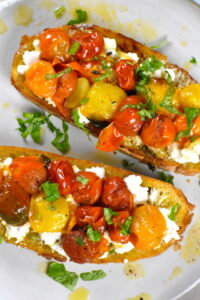
The Italian bread salad that improves as it sits, which is exactly what a potluck needs. Day-old bread, cherry tomatoes, basil, oregano, red onion, olive oil, vinegar. Made 2 to 3 hours before the gathering so the bread softens just enough.
Ingredients (serves 10): 4 cups cubed day-old bread (torn into 1-inch pieces), 4 cups halved cherry tomatoes, 1/2 cup torn basil, 2 tablespoons chopped oregano, 1/2 red onion (thinly sliced), 1/3 cup olive oil, 2 tablespoons red wine vinegar, 1 teaspoon flaky salt.
Dish 3: Garden grain bowl with chimichurri
A pantry-driven side that holds at room temperature for the duration of a potluck. Cooked farro or wheat berries (made the day before), fresh chimichurri (parsley, cilantro, oregano, garlic, vinegar, olive oil), and halved cherry tomatoes. Vegan, hearty, transports in a single container.
Ingredients (serves 10 to 12): 3 cups cooked farro or wheat berries (cooled), 2 cups halved cherry tomatoes, 1 cup chimichurri sauce, 1/2 cup crumbled feta (optional), salt and pepper.
Dish 4: Cucumber, mint, and yogurt dip
The cold dip that’s safe at room temperature for 2 hours, refreshing on a hot July afternoon, and improves overnight. Greek yogurt, cucumber, mint, dill, lemon, garlic. Serve with pita chips, vegetables, or warm flatbread.
Ingredients (serves 12): 2 cups Greek yogurt, 1 large cucumber (grated, squeezed dry), 1/4 cup chopped mint, 2 tablespoons chopped dill, 1 tablespoon lemon juice, 1 grated garlic clove, 1 teaspoon flaky salt.
Dish 5: Strawberry and basil shortbread bars
Dessert that travels in a single pan. Buttery shortbread base, strawberry jam middle (made from fresh garden strawberries the day before), basil-sugar topping. Holds for 24 hours at room temperature, cut into squares for easy serving.
Ingredients (makes 16 bars): 2 cups flour, 1/2 cup powdered sugar, 1 cup softened butter, pinch of salt, 1.5 cups fresh strawberry jam (or quick-cook strawberries with sugar), 2 tablespoons chopped basil mixed with 1/4 cup sugar for topping.
Dish 6: Lemon-thyme iced tea (gallon batch)
Every potluck needs more drinks than food. A gallon of fresh-brewed iced tea infused with thyme simple syrup and lemon serves 20 people, is alcohol-free (essential for a family-friendly gathering), and reads as serious in a way that grocery-store lemonade doesn’t.
Ingredients (makes 1 gallon): 8 black tea bags, 1 cup thyme simple syrup (1 cup water + 1 cup sugar steeped with 1/2 cup fresh thyme, strained), juice of 4 lemons, 1 gallon cold water, ice, fresh thyme sprigs for garnish.
What to bring if you’re attending, not hosting
If you’re attending an America’s Potluck rather than hosting one, the choice of dish matters more than the quantity. A useful guest brings something that:
- Scales for any size gathering (a chimichurri or compound herb butter elevates whatever the host already prepared)
- Survives transport without ice (skip mayo-based dishes unless you’re driving five minutes or less)
- Includes visible garden herbs (a dish with fresh basil, mint, or chives stands out on a table of grocery-store salads)
- Travels in a sealed container (the host has enough dishes to wash already)
- Solves a problem the host probably has (a gallon of iced tea, a serious dessert, or a vegetable-forward dish for vegetarian guests)
The best universal contributions: a jar of slow-roasted cherry tomatoes with herbs (uses Gardyn cherry tomatoes and basil, holds for two weeks refrigerated, works as a topping for almost anything); a fresh chimichurri (uses Gardyn cilantro and oregano, elevates any grilled protein); or a gallon of herb-infused lemonade (uses Gardyn mint and thyme, solves the drinks shortfall every potluck has).
Food safety for an outdoor July 5th potluck
The USDA 2-hour rule applies. Perishable foods (anything cooked, anything with dairy, anything with eggs, cooked grains, cut fruit) should not sit at room temperature for more than 2 hours, or 1 hour if the outdoor temperature is above 90 degrees Fahrenheit. This is the single most common potluck mistake and it’s entirely avoidable.
Practical protocol for a 3-to-4-hour potluck:
- Keep backup dishes in coolers or refrigerators. Replace the serving bowls every 90 minutes.
- Use small platters that empty quickly rather than one giant serving bowl that sits for hours.
- Set the dessert bar out only when it’s time for dessert.
- Pour-over coffee or hot water for tea is safer than a pre-poured carafe.
- Cooked dishes that need to stay warm (a casserole, a tray of pulled pork) should be held in a warm oven or chafing dish at 140 degrees F or above, not on the counter.
The two-holiday garden setup
July 4th and July 5th are 24 hours apart and serve different food needs. The Fourth is grilling and big-flavor cookout fare. The Fifth is slower, room-temperature-friendly, conversation-paced food. A Gardyn column produces ingredients for both.
For both holidays, a Gardyn Home column (30 plant slots) planted in early June produces continuously through both days. Suggested loadout:
- 3 cherry tomato yCubes (for the Block Party menu, the panzanella, and the grain bowl)
- 8 herb yCubes: basil, mint, cilantro, oregano, parsley, thyme, dill, chives
- 2 strawberry yCubes (for the shortbread bars and any Fourth-of-July dessert)
- 2 cucumber yCubes (for the yogurt dip and any cold salad)
- 4 lettuce yCubes (romaine, arugula, butterhead, red sails)
- Microgreens running on continuous rotation from a Microgreens Kit for garnish on the Block Party burgers and the Potluck sliders
- Remaining slots for specialty greens or peppers
Total active maintenance through the holiday weekend: about 15 minutes a day for harvesting. No grocery runs between the two events.
Why Gardyn fits America’s Potluck specifically
The official toolkit emphasizes that diverse contributions are the point. Everyone brings something different. The dish you bring should look and taste like something that came from your home, not from the grocery store five minutes away.
Garden-grown ingredients are the most visible signal of that distinction. A panzanella made with same-day-picked cherry tomatoes and basil tastes meaningfully different from one built on grocery produce. The herbs in your chimichurri were on the plant 20 minutes before they hit the bowl. Strawberries from a yCube ripened to peak sweetness rather than being picked unripe for shipping. The whole point of the potluck is that what you bring is *yours*, and the easiest way to make a contribution that’s actually yours is to grow part of it.
| Grow the herbs and ingredients America’s Potluck deserves
A Gardyn floor column produces cherry tomatoes, herbs, strawberries, and salad greens through both the Fourth of July and America’s Potluck weekend, with no grocery runs between. |
Frequently asked questions
Is America’s Potluck a real federal event?
Yes. America’s Potluck is the official closing-day event of the Semiquincentennial week, organized by the America250 Utah Commission with backing from the federal America250 commission. More than 70 national partners are involved, including the American Legion and Interfaith America. The event is endorsed by governors and state commissions across all 50 states and Puerto Rico.
What date is America’s Potluck?
Sunday, July 5th, 2026. The date was chosen specifically because it falls on a Sunday, building on the American tradition of Sunday dinner. It is the day after the Fourth of July, 2026, the 250th anniversary of the signing of the Declaration of Independence.
How do I sign up to host an America’s Potluck?
Visit america250.utah.gov/americaspotluck (the official site) and follow the registration link. Hosts receive a free toolkit with conversation prompts, decoration ideas, recipes, and facilitation guides. Registered public events appear on the nationwide interactive map. You can also organize a private gathering without registering.
How do I find an America’s Potluck near me?
The interactive map on the official America’s Potluck site lists registered public events by ZIP code. State and local America250 commissions, American Legion posts, faith communities, and civic organizations are hosting many of the public events.
Is America’s Potluck political?
No. The event is explicitly nonpartisan, and the official toolkit advises hosts to avoid politicized debate. The framing is community connection across differences, not policy discussion. The conversation activities (Talk Better Together, Shared Values Dialogue) are designed to find common ground rather than score points.
What if I don’t want to do the structured conversation activities?
That’s fine. The official toolkit treats the conversation activities as optional. Many hosts will skip them entirely and let people eat and talk naturally. The core goal is simply gathering with neighbors over a shared meal.
What’s the difference between America’s Block Party and America’s Potluck?
America’s Block Party is the federal celebration on July 4th, 2026, focused on synchronized neighborhood Fourth-of-July gatherings with live music and patriotic events. America’s Potluck is the quieter closing event on July 5th, focused on community conversation around a shared meal. Many households will participate in both. They’re complements, not alternatives.
What food should I bring to America’s Potluck?
Something make-ahead that travels well and holds at room temperature within the USDA 2-hour rule. A herb-driven garden salad, a chimichurri or compound butter, a jar of slow-roasted tomatoes, or a gallon of fresh herb-infused iced tea are all strong picks. Skip mayo-based dishes unless you’re driving a short distance with ice.
Will America’s Potluck happen every year, or just for the 250th?
Officially, the 2026 event is the inaugural celebration tied to the Semiquincentennial. Whether it becomes an annual tradition depends on participation and follow-through by the organizers and state commissions. The official goal of 25,000 gatherings nationwide in 2026 is the benchmark, and strong participation would likely lead to continuation in future years.
How is America’s Potluck connected to the Fourth of July?
America’s Potluck is the official closing event of the Semiquincentennial week, which begins with a special Times Square ball drop at midnight on July 3rd, peaks with America’s Block Party on July 4th, and concludes with America’s Potluck on July 5th. Together the three days form what the federal America250 commission calls America’s Day of Reflection, the structured commemoration of the 250th anniversary.