Cookies help us deliver the best experience on our website. By clicking Accept you are agreeing to the placement and use of cookies as described in our privacy policy.


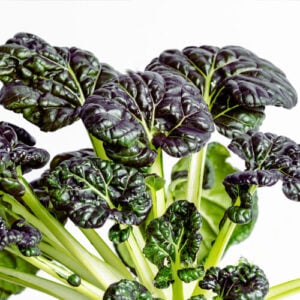
Tatsoi is a Chinese cabbage variety (Brassica rapa var. narinosa) that looks like a miniature bok choy arranged in a rosette pattern, with dark green, spoon-shaped leaves and a mild, slightly mustardy flavor. It is a staple in East Asian cooking but remains largely unknown to most North American home cooks. This unfamiliarity is a nutritional opportunity.
Tatsoi combines the cruciferous health benefits of its Brassicaceae family membership, including glucosinolates, with an exceptional micronutrient profile that makes it one of the more nutritionally comprehensive greens available to grow at home.
Key takeaways
- Tatsoi provides ~45mg of vitamin C per 100g, comparable to watercress and higher than most commonly consumed leafy greens.
- Tatsoi contains sinigrin and gluconasturtiin as its primary glucosinolates, converting to allyl isothiocyanate and PEITC, both studied for anti-cancer activity in multiple cancer cell lines.
- Like other Brassicaceae vegetables, tatsoi has low oxalate content, making its calcium (~105mg per 100g) and iron (~1.5mg per 100g) among the more bioavailable in the leafy green category.
- Tatsoi is rich in lutein and zeaxanthin, carotenoids specifically concentrated in the retina and studied for protection against age-related macular degeneration.
- Tatsoi grows in a low rosette rather than upright stalks, making it more compact and better suited to growing systems with limited vertical space than bok choy.
- The myrosinase enzyme that converts glucosinolates to active isothiocyanates is destroyed above ~70°C, eating tatsoi raw or briefly cooked, chewed thoroughly, maximizes phytochemical delivery.
Tatsoi’s nutritional profile
Vitamin C and immune function
Tatsoi provides approximately 45mg of vitamin C per 100g, comparable to watercress and higher than most commonly consumed leafy greens. As a cruciferous vegetable, tatsoi’s vitamin C is paired with glucosinolates and other phytochemicals that contribute to its overall antioxidant capacity beyond what vitamin C alone provides.
Vitamin A: beta-carotene and lutein
Tatsoi is rich in beta-carotene (vitamin A precursor) expressed in dark green form by the preponderance of chlorophyll. It also contains significant lutein and zeaxanthin. A meta-analysis published in JAMA Ophthalmology found that lutein and zeaxanthin intake was significantly associated with lower risk of age-related macular degeneration and cataracts.
Glucosinolates: the cruciferous advantage
Tatsoi contains sinigrin and gluconasturtiin as its primary glucosinolates, converting to allyl isothiocyanate and phenethyl isothiocyanate (PEITC) upon enzymatic activation by chewing. Both have demonstrated anti-cancer activity in laboratory studies, with PEITC showing particular activity against breast, prostate, and lung cancer cell lines. These are the same mechanisms that make arugula, watercress, and kale nutritionally distinguished.
Tatsoi versus bok choy: how they compare
 Tatsoi and bok choy are closely related, but tatsoi has higher concentrations of most vitamins and more intense flavor. Tatsoi also grows in a low rosette rather than upright stalks, making it more compact and suitable for growing systems with limited vertical space. For home growing purposes, tatsoi’s denser growth and higher nutrient density per plant makes it more efficient than bok choy in the same space.
Grow bok choy at home if you prefer the milder, crunchier alternative.
How to cook and use tatsoi
Raw in salads
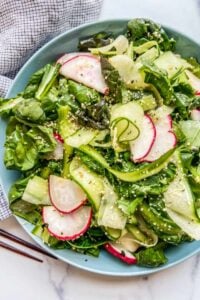
Young tatsoi leaves are tender enough to eat raw. The mild mustardy flavor pairs well with sesame-based dressings, miso vinaigrettes, and citrus. It is milder than arugula and more interesting than romaine.
Stir-fry
The classic preparation: tatsoi wilts quickly in a hot wok with garlic and ginger. Its thick stems hold up to high-heat cooking better than delicate greens like spinach, while the leaves wilt to a silky texture within 60 to 90 seconds. See the Gardyn recipe for cooking with tatsoi.
Frequently asked questions
Is tatsoi the same as bok choy?
They are closely related members of the Brassica rapa species but are different varieties. Tatsoi forms a low rosette with darker, more rounded leaves. Bok choy grows upright with distinct pale stalks and broader leaves. Tatsoi is more compact and has a slightly more intense flavor.
Is tatsoi high in goitrogens?
Like all cruciferous vegetables, tatsoi contains goitrogenic compounds that can interfere with thyroid iodine uptake in very large quantities. At typical culinary amounts, this is not a concern for people with normal thyroid function and adequate iodine intake.
What is the best way to maximize tatsoi’s glucosinolate content?
Eat it raw or briefly cooked. Chew thoroughly to activate myrosinase and convert glucosinolates to active isothiocyanates. Overcooking denatures myrosinase and reduces active compound production significantly.