Cookies help us deliver the best experience on our website. By clicking Accept you are agreeing to the placement and use of cookies as described in our privacy policy.


Every March the same wave of content arrives: juice cleanses, detox teas, liver-support supplements, and seven-day resets promising to undo winter. The claims are compelling. The science, mostly, is not.
The good news is that something genuinely useful does happen when you shift to eating more fresh greens in spring. It just isn’t a detox in any marketing sense of the word. Here is what the research actually shows, which plants are involved, and why growing them at home changes the equation.
Key takeaways
- Detoxification is a real physiological process, your liver runs two overlapping phases of biotransformation continuously. What it
 needs is the raw materials that fresh food provides, not a periodic cleanse to restart it.
 - Phase two liver detoxification draws heavily on sulfur-containing amino acids, glutathione precursors, and folate, all of which decline in winter diets dominated by stored and processed foods.
- Bitter greens like arugula, watercress, and sorrel stimulate bile production, a genuine, measurable mechanism for clearing fat-soluble waste products, but work gradually over weeks, not days.
- Glucosinolates in arugula and watercress convert to isothiocyanates that upregulate phase two detoxification enzymes, a well-documented mechanism in multiple human cell studies.
- Juice cleanses remove the fiber that is most directly responsible for supporting waste elimination, the central irony of liquid detox programs.
- Home-grown greens harvested minutes before eating deliver folate and vitamin C, the two nutrients most critical to liver detox support, at or near peak values, not at the depleted levels of week-old store produce.
What ‘detox’ actually means biologically
Phase one and phase two liver detox
Detoxification is a real physiological process. Your liver runs two overlapping phases of biotransformation that convert fat-soluble toxins, hormones, and metabolic waste into water-soluble compounds your kidneys can excrete. This happens continuously, without breaks, and without needing a cleanse to restart it.
Phase one converts toxins into intermediate compounds using cytochrome P450 enzymes, these require B vitamins, magnesium, and antioxidants to function. Phase two conjugates those intermediates for excretion and draws heavily on sulfur-containing amino acids, glutathione precursors, and folate. Both phases benefit from consistent dietary supply, not periodic loading.
| The problem with detox teas and juice cleanses
Most commercial detox products are either laxatives or diuretics. They produce a visible result (more frequent bathroom visits) that feels like cleansing but is simply accelerated fluid and fiber transit. Neither process meaningfully changes how your liver handles toxins. |
What happens to your body in early spring
After months of lower light exposure, reduced physical activity, and a diet heavier in stored and processed foods, many people enter March with lower vitamin D levels, reduced glutathione stores, slightly elevated inflammatory markers, and disrupted circadian rhythms. Increasing fresh leafy green consumption directly addresses several of these, not as a detox, but as nutritional replenishment through ordinary mechanisms that have been well studied.
The greens that provide genuine spring-reset value
Arugula: glucosinolates and liver enzyme support
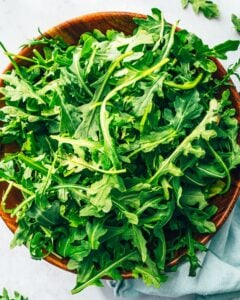 Arugula is rich in glucosinolates that convert to isothiocyanates during digestion. Isothiocyanates have been shown to upregulate phase two detoxification enzymes in animal and human cell studies through the NRF2 pathway. This is a well-supported mechanism for reducing oxidative load, not a detox claim.
Grow arugula at home. See also arugula salad recipes.
Watercress: the most nutrient-dense green by clinical measure
The CDC’s Powerhouse Fruits and Vegetables study ranked watercress first among all 47 foods assessed, scoring 100 out of 100 for nutrient density. It is particularly high in vitamin K, vitamin C, vitamin A, and the glucosinolate phenethyl isothiocyanate (PEITC), which has been studied for its role in supporting glutathione synthesis.
Spinach: folate, magnesium, and glutathione precursors
Spinach provides two of the most commonly depleted nutrients after winter: folate and magnesium. Folate is essential for methylation, a process central to phase two liver detox and to the recycling of glutathione. Magnesium is required by hundreds of enzymatic reactions including several in the detox cascade.
The difference in folate content between just-harvested and week-old spinach is significant enough that why eating at harvest is healthier is a subject Gardyn has covered in depth.
What actually supports liver function in spring
Consistent fiber intake
Fiber supports the elimination phase by binding to bile acids and cholesterol in the gut, preventing their reabsorption. Whole leafy greens deliver fiber intact. Juice cleanses, by definition, do not. This is the central irony of liquid detox programs: they remove the component most directly responsible for supporting waste elimination.
Adequate protein
Phase two liver detox requires amino acids, particularly glycine, taurine, glutamine, and cysteine, to conjugate toxins. A spring diet heavy in juice and light in protein actually impairs this process. Pairing fresh greens with adequate protein sources is better supported by the science than any juice protocol.
Hydration from whole foods
Lettuces, watercress, and cucumber are 90 to 96 percent water by weight. Including them in daily meals contributes meaningfully to hydration without requiring any additional effort. Hydration directly supports kidney function, which is the actual excretory organ most affected by spring dietary shifts.
Frequently asked questions
Does a juice cleanse actually remove toxins?
No. Your liver and kidneys remove toxins continuously. A juice cleanse does not enhance this process and may impair phase two detox by reducing protein intake. Fresh whole greens provide better nutritional support than any juice protocol.
Which greens are most effective for spring liver support?
Arugula, watercress, and spinach are the best-studied for compounds that support liver enzyme activity. Bitter greens in general stimulate bile production. Growing them at home ensures you eat them at peak nutrient density.
How long does it take to see a difference from eating more greens?
Measurable changes in inflammatory markers and nutrient levels can appear within two to four weeks of consistent higher intake. The effects are cumulative, not immediate, which is why periodic cleanses are less effective than daily habit change.