Cookies help us deliver the best experience on our website. By clicking Accept you are agreeing to the placement and use of cookies as described in our privacy policy.


Sorrel is the herb that tastes like lemon but grows like a weed. Its sharp, citrusy flavor comes from oxalic acid, the same compound that gives rhubarb its pucker and spinach its slightly astringent aftertaste. Unlike rhubarb, sorrel leaves are mild enough to eat in salads, assertive enough to brighten sauces, and nutritious enough to use in meaningful quantities.
Key takeaways
- Fresh sorrel leaves contain approximately 48 to 70mg of vitamin C per 100g, significantly higher than many other leafy greens and comparable
 to citrus juice by weight.
 - Sorrel provides approximately 2.4mg of iron and 103mg of magnesium per 100g, notably high magnesium for a leafy herb, comparable to spinach.
- Sorrel’s primary flavor compound is oxalic acid, which provides tartness and acts as a natural lemon substitute in cooking, adding brightness without additional citrus.
- Sorrel contains quercetin, kaempferol, and vitexin among its flavonoid content, all with demonstrated anti-inflammatory and antioxidant activity consistent with other quercetin-rich plants.
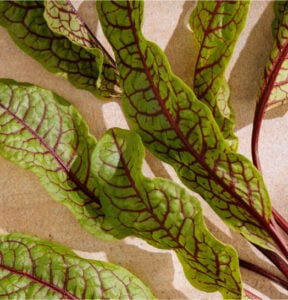
- Red sorrel (Rumex sanguineus) has striking red-veined leaves and a milder flavor than common sorrel, better for raw applications; common sorrel is more assertive and better for cooked preparations.
- Sorrel is high in oxalic acid, which binds to some calcium and iron, reducing their absorption. At normal culinary quantities, this is not a concern for most healthy adults.
What is sorrel?
Rumex acetosa (common sorrel) is a perennial herb native to Europe and Asia, long used in French, Scandinavian, and Eastern European cooking. It is closely related to dock and rhubarb (all in the Polygonaceae family) and shares their characteristic tart, acidic flavor from high oxalic acid content. Red sorrel (Rumex sanguineus) has a milder flavor and striking red-veined leaves.
Gardyn includes red sorrel as a yCube variety. See the August plant release page for details.
Sorrel’s nutritional profile
Vitamin C: comparable to citrus by weight
Fresh sorrel leaves contain approximately 48 to 70mg of vitamin C per 100g, significantly higher than many other leafy greens and comparable to orange juice by weight. Replacing lemon juice with fresh sorrel in a sauce or dressing provides vitamin C alongside flavor. Research on vitamin C bioavailability from whole food sources consistently shows better absorption and sustained plasma levels from whole plant sources compared to isolated supplements.
Iron and magnesium
Sorrel provides approximately 2.4mg of iron and 103mg of magnesium per 100g. Its magnesium content is notably high for a leafy herb, comparable to spinach. The oxalic acid that gives sorrel its flavor binds to some calcium and iron, reducing their absorption compared to low-oxalate vegetables. For iron and magnesium specifically, pairing sorrel with vitamin C (which sorrel itself provides) supports iron absorption.
How to use sorrel
As a lemon substitute
Wherever a recipe calls for lemon juice for brightness, fresh sorrel leaves provide the same acidity with additional nutritional value. Sorrel sauce for fish, sorrel in cream-based pasta, and sorrel in salad dressing are all classic French preparations that work because oxalic acid in sorrel provides tartness without the sharp single-note of citrus.
 Raw in salads
Young sorrel leaves, particularly from red sorrel varieties, work as a salad component when balanced with milder greens. A mix of romaine, arugula, and red sorrel creates an interesting flavor contrast with complementary nutritional profiles. Use sorrel as an accent rather than a base due to its strong flavor.
In soups and sauces
Classic sorrel soup involves wilting sorrel in butter and blending with stock. Sorrel cream sauce over poached eggs or fish is a traditional French preparation that works beautifully with home-grown varieties.
Frequently asked questions
Is sorrel safe to eat in large quantities?
Sorrel is high in oxalic acid, which can be problematic in very large quantities for people prone to kidney stones. At culinary quantities (a handful of leaves), it is safe for most healthy adults.
Does cooking reduce sorrel’s nutritional value?
Brief cooking preserves most minerals and some vitamins. Vitamin C, being heat-sensitive, declines with cooking. Using raw sorrel for its vitamin C contribution and cooked sorrel for flavor in sauces covers both applications.
Can I grow sorrel year-round in a Gardyn system?
Yes. The Gardyn system maintains the consistent moisture and temperature that sorrel grows well in, making year-round production practical without outdoor seasonal requirements.