Cookies help us deliver the best experience on our website. By clicking Accept you are agreeing to the placement and use of cookies as described in our privacy policy.


Purple basil is the variety most home cooks have never used and most professional kitchens lean on constantly. The deep purple-black leaves are stunning visually, the flavor profile is spicier and more clove-like than green basil, and the herb makes one of the most striking finishing ingredients available: a vivid pink infused vinegar that turns ordinary dressings into something visually unforgettable.
Here’s the full guide to purple basil: how to grow it indoors, how it differs from green basil in the kitchen, and how to make the pink vinegar that’s its single best use.
Key takeaways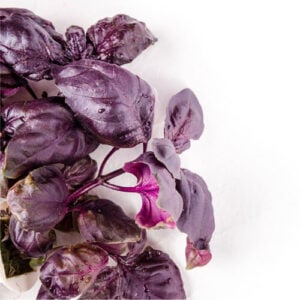
- Purple basil is a distinct variety from green (sweet) basil with a spicier, more clove-forward flavor and dramatic purple-black leaves.
- The same growing conditions that work for green basil work for purple basil indoors: full-spectrum light, stable water, regular pinching.
- Purple basil shines in fresh applications: salads, infused oils, garnishes, and especially pink basil vinegar.
- Pink basil vinegar is made by steeping fresh purple basil in white wine vinegar. The leaves leach their color and create a vivid pink finished product.
- An indoor garden produces enough purple basil for both kitchen use and decorative finishes through the entire summer.
Purple basil vs. green basil
Purple basil and sweet (green) basil are different cultivars of the same species, Ocimum basilicum. Both grow under the same conditions, but the flavor and visual impact differ significantly.
Flavor
Green basil has the familiar sweet, anise-like flavor at the center of Italian cooking. Purple basil is spicier, with stronger notes of clove and sometimes a hint of cinnamon. The flavor compound responsible for the difference is methyl eugenol, which is more concentrated in purple varieties.
Color
Purple basil leaves range from deep purple-black to dark burgundy depending on the cultivar. The color comes from anthocyanins, the same antioxidant pigments that give blueberries and red cabbage their color. The pigments are water-soluble, which is what makes the pink vinegar possible.
Best uses
Green basil is for cooking (pesto, pasta sauces, tomato dishes). Purple basil is for visual impact and infusions (salads, garnishes, vinegars, cocktails). They’re not interchangeable; each does something the other can’t.
 How to grow purple basil indoors
Light
Purple basil needs the same light intensity as green basil: 12 to 14 hours of full-spectrum LED light per day. The anthocyanins that give the leaves their color actually develop more strongly under bright light, so a well-lit indoor system produces more vibrant color than under-lit windowsill growing.
Water and nutrients
Stable hydration is the single most important variable. Basil bolts (sends up flower stalks and gets bitter) under water stress. The Hybriponic™ system delivers consistent water and nutrients automatically, which is why basil tends to thrive in a Gardyn for far longer than in pots.
Pinching
Purple basil, like all basil, should be pinched regularly. When the plant develops two sets of true leaves, pinch the central growing tip just above the second set. This forces branching and produces a bushier plant with more leaves. Pinch again every two weeks. Never let the plant flower; flowering ends leaf production.
Harvest timing
First harvest at about 4 weeks. Pick from the top, taking leaves and stem just above a leaf node so the plant branches at that point. A single purple basil yCube produces continuously for 12 to 16 weeks with regular pinching.
Cooking with purple basil
Purple basil belongs in fresh applications where its flavor and color show. Heat dulls the color (the anthocyanins denature) and softens the flavor, so cooked applications are not the best use.
Best uses
- Salads, especially those with tomato, peach, watermelon, or stone fruit.
- Garnish for grilled fish, chicken, or vegetables (placed on after cooking).
- Infused vinegars, oils, and simple syrups.
- Cocktails (basil-gin, basil-vodka, basil-rum).
- As the visual contrast in any green-herb dish.
Avoid
- Pesto (the color turns muddy).
- Long-cooked sauces (color and flavor both fade).
- Dried (the color and flavor mostly disappear).
| “Purple basil is the herb that makes people stop and ask what they’re looking at. The pink vinegar is the same effect bottled.”
Gardyn test kitchen |
The pink basil vinegar trick
This is the single most striking use of purple basil and the one most people don’t know about. Steep fresh purple basil leaves in white wine vinegar for 24 to 48 hours and the vinegar turns vivid pink, with a gentle basil-and-clove flavor running through it. Use it on salads, fish, summer fruits, or as a finishing acid on anything roasted or grilled.
Pink basil vinegar recipe
- 1 cup white wine vinegar (or champagne vinegar)
- 1 cup loosely packed fresh purple basil leaves
Method
Wash and dry the purple basil leaves. Bruise them lightly with the back of a knife or by tearing them roughly. Place in a clean glass jar.
Heat the vinegar to just below a simmer (do not boil; you want gentle warmth to extract the color faster). Pour over the basil leaves. Seal the jar and let it sit at room temperature, out of direct light, for 24 to 48 hours.
Strain out the leaves through a fine-mesh sieve. The vinegar will be a vivid pink. Store in a clean bottle in a cool, dark place for up to 6 months.
Ways to use pink basil vinegar
- Vinaigrettes (just olive oil, salt, pepper, and pink basil vinegar).
- Drizzled over watermelon, strawberries, or peaches.
- Finishing splash on grilled fish or chicken.
- In a Martini or Gibson in place of standard vinegar.
- As a host gift in a small decorative bottle.
Other uses worth knowing
Purple basil simple syrup
Make a 1:1 simple syrup (1 cup sugar, 1 cup water, simmered until dissolved), then add 1 cup of bruised purple basil leaves off the heat. Steep 30 minutes, strain. The syrup turns pink and works in cocktails, lemonade, or drizzled over fruit.
Purple basil oil
Blanch purple basil leaves in boiling water for 5 seconds, then plunge into ice water (this sets the color). Pat dry. Blend with a neutral oil (grapeseed, light olive) in a ratio of 1 cup leaves to 1 cup oil. Strain through cheesecloth. Use as a dramatic garnish or finishing drizzle.
| Grow the basil restaurants use and home cooks miss
A Gardyn floor column grows purple basil alongside green basil and the other herbs you need. Memorial Day sale is on now. |
Frequently asked questions
Can I substitute purple basil for green basil in recipes?
Sometimes. Purple basil has a slightly stronger, more clove-forward flavor and turns muddy in cooked applications. For fresh uses (salads, garnishes), they’re interchangeable in most recipes.
Does purple basil need more light than green basil?
No, but bright light intensifies the purple color. Under low light, purple basil can develop greener leaves with less visual impact. A full-spectrum indoor grow light gives you the deepest color.
How long does pink basil vinegar last?
Up to 6 months in a cool, dark place. The color may fade slightly over time but the flavor holds well. For maximum visual impact, make it in smaller batches and use within 2 to 3 months.
Can I dry purple basil for later?
Yes, but the color fades dramatically and the flavor changes. If you want to preserve purple basil, the vinegar, oil, or simple syrup methods preserve flavor and color better than drying.
Will purple basil cross-pollinate with green basil in my Gardyn?
Not in a way that affects the leaves you harvest. Cross-pollination would only matter if you were saving seeds. Both varieties grow happily alongside each other in the same column.
What’s the difference between purple basil, opal basil, and Thai basil?
Opal basil is a specific cultivar of purple basil (Dark Opal is the most common). Thai basil is a different species (Ocimum basilicum var. thyrsiflora) with a stronger anise-licorice flavor used in Southeast Asian cooking. All three have purple or partially purple stems and leaves.