Cookies help us deliver the best experience on our website. By clicking Accept you are agreeing to the placement and use of cookies as described in our privacy policy.


Grow lights are the make-or-break factor for indoor plant success. Most homes do not have windows bright enough to sustain productive herb and vegetable growth year-round – even a south-facing window provides only a fraction of the light intensity plants need for healthy growth. LED grow lights solve this, but the category is crowded, the terminology is confusing, and the wrong light means disappointing results.
This guide covers everything you need to evaluate an LED grow light: the science behind spectrum and intensity, the specs that actually matter, what to ignore, and why integrated lighting systems outperform buying separate lights for most home growers.
Key takeaways
- Full-spectrum LED lights that cover both the blue (400–500 nm) and red (600–700 nm) ranges are necessary for
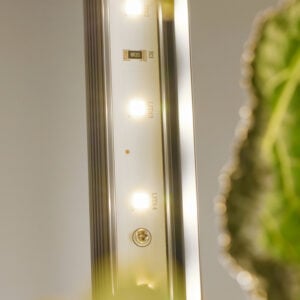 complete plant growth – blue for foliage, red for fruiting and flowering.
 - PPFD (photosynthetic photon flux density) measured in μmol/m²/s is the most useful metric for evaluating grow light intensity. Most herbs and greens need 200–400 μmol/m²/s; fruiting plants need 400–600+.
- Light schedule matters as much as intensity: most herbs and greens grow best under 16–18 hours of light per day.
- Buying grow lights separately from your growing system introduces positioning, heat, and scheduling complexity that integrated systems eliminate.
- Gardyn’s built-in full-spectrum LEDs run on Kelby-managed schedules optimised for each plant variety – no separate purchase or setup required.
Why indoor plants need artificial light
Plants use light for photosynthesis: converting light energy, water, and carbon dioxide into glucose and oxygen. The light intensity required for this process is far higher than most people expect.
A sunny south-facing window in North America delivers approximately 1,000–2,000 foot-candles (10,000–20,000 lux) on a clear summer day. Herbs like basil need around 6,000–10,000 lux to grow productively. On overcast days or in winter, window light can drop below 500 lux – not enough for healthy growth.
LED grow lights compensate by delivering the right spectrum and intensity consistently, regardless of season, weather, or window orientation. For a deeper look at how light affects plant growth, see the full spectrum grow lights guide.
The key specifications explained
Spectrum: the most important factor
Plants do not use all wavelengths of light equally. Chlorophyll, the pigment responsible for photosynthesis, absorbs light most efficiently in two ranges:
- Blue light (400–500 nm): drives vegetative growth, leaf development, and compact, bushy plant structure
- Red light (620–700 nm): drives flowering, fruiting, and stem elongation
Full-spectrum LED lights cover both ranges, plus the green and yellow wavelengths in between. This matters because plants absorb some light across the whole visible spectrum, and full-spectrum lighting more closely replicates natural sunlight.
Grow lights marketed as “blue/red only” or “purple lights” cover the chlorophyll absorption peaks but skip the intermediate wavelengths. Research suggests full-spectrum coverage produces better growth outcomes for most crops, and full-spectrum lights are easier to work around visually in a home environment.
PPFD: the intensity metric that matters
PPFD (photosynthetic photon flux density) measures how many light photons – specifically in the photosynthetically active range of 400–700 nm – land on one square meter per second. It is expressed in μmol/m²/s (micromoles per square meter per second).
This is the most useful specification when evaluating grow lights because it tells you how much usable light actually reaches your plants.
| Plant type | PPFD required | Notes |
|---|---|---|
| Microgreens | 100–200 μmol/m²/s | Low light requirement |
| Lettuce and leafy greens | 200–400 μmol/m²/s | Gardyn’s LED range |
| Herbs (basil, mint, cilantro) | 200–400 μmol/m²/s | Consistent with leafy greens |
| Fruiting plants (tomatoes, peppers) | 400–600+ μmol/m²/s | Higher intensity needed |
Wattage: less useful than you think
 Wattage measures electricity consumption, not light output. Two lights can consume the same wattage and produce very different PPFD values depending on LED efficiency. Modern high-efficiency LEDs produce significantly more PPFD per watt than older technology.
Wattage is useful for estimating electricity costs but should not be your primary selection criterion. PPFD at the canopy is the metric that determines plant performance.
Coverage area
Grow light manufacturers quote coverage areas, but these are often measured at lower PPFD thresholds than your plants need. A light quoted as covering 4×4 feet may deliver adequate PPFD for leafy greens at that area, but may need to be positioned much closer for fruiting plants.
For home growing, prioritise PPFD at the distance you will position the light over the quoted coverage area.
Light schedule (photoperiod)
Plants need both light and darkness. The ratio of light to dark – the photoperiod – affects growth rate and triggers flowering in some species.
- Herbs and leafy greens: 16–18 hours of light, 6–8 hours dark. Long-day plants that grow fastest with extended light exposure.
- Fruiting plants: 12–14 hours of light. Some require shorter days to trigger flowering.
- Seedlings and young plants: 18 hours light is common during establishment.
Consistent scheduling is important – plants benefit from a predictable light cycle. Manual timers work but add a layer of management that automated systems eliminate.
| Heat and LED grow lights
LED lights generate significantly less heat than older HID (high-intensity discharge) or fluorescent grow lights, making them the standard for home growing. However, high-wattage LEDs do generate some heat, and positioning matters – lights placed too close to plants can cause leaf bleaching or tip burn even at appropriate PPFD levels. Most LED grow light manufacturers provide a recommended distance range. For integrated systems like Gardyn, this is handled by the product design. |
Why integrated grow lights outperform separate purchases for home growers
Buying a grow light separately from your growing system introduces three problems:
- Positioning: the light must be suspended at the correct height and adjusted as plants grow. Too close causes bleaching; too far causes stretching.
- Spectrum matching: not all grow lights are optimised for the plant varieties you are growing. Generic lights may under-perform for specific crops.
- Scheduling: a separate timer is required to manage the light cycle, adding another point of failure and setup effort.
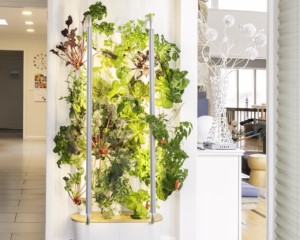
Gardyn’s Hybriponic™ system includes full-spectrum LEDs integrated into the system design. Kelby AI manages the light schedule automatically, adjusting cycles by plant variety. There is no light to purchase, position, or schedule separately. For a full discussion of how Gardyn’s lighting works, see the full spectrum grow lights article.
Evaluating LED grow lights: what to look for
For leafy greens and herbs
- Full-spectrum coverage (400–700 nm minimum)
- PPFD of 200–400 μmol/m²/s at your intended growing distance
- Timer included or compatible
- Low heat output for close-range positioning
- Energy efficiency: look for ≥2.0 μmol/J (micromoles per joule)
For fruiting plants and mixed gardens
- Full-spectrum coverage including deep red (660 nm) and far-red (720–740 nm) for flowering triggers
- PPFD of 400–600+ μmol/m²/s at canopy height
- Adjustable height mounting system
- Dimming capability for seedling stage vs mature plant stage
Specifications to be sceptical about
- Quoted “wattage” without PPFD data: often misleading
- Coverage area claims without specifying PPFD at that area
- PAR (photosynthetically active radiation) without PPFD: PAR is a range, not a measurement
- Lux measurements: lux measures light as perceived by human eyes, not photosynthetic efficiency
| Skip the grow light research entirely |
| Gardyn’s Hybriponic™ system includes full-spectrum LEDs optimised for each plant variety – managed automatically by Kelby AI. No separate light purchase, no positioning, no scheduling. |
Further reading: Bugbee (2017) – Economics of LED lighting for plant growth; Cornell CEA – Hydroponic production and lighting; NASA – Plant growth lighting for space agriculture
Frequently asked questions
What spectrum of LED is best for growing plants?
Full-spectrum LEDs covering 400–700 nm are best for most plants. Ensure coverage of both the blue range (400–500 nm) for vegetative growth and the red range (620–700 nm) for flowering and fruiting. For herbs and leafy greens, a balanced full-spectrum light is sufficient.
How many watts of LED do I need to grow herbs indoors?
Wattage is less useful than PPFD. For herbs and leafy greens, aim for 200–400 μmol/m²/s at canopy height. As a rough guide, a quality LED delivering 30–50 true watts can cover a 2×2 foot area adequately for herbs. Actual PPFD depends on the specific light and positioning.
Do LED grow lights use a lot of electricity?
LED grow lights are significantly more energy-efficient than HID or fluorescent alternatives. Running a 45-watt LED for 16 hours per day uses approximately 0.72 kWh per day – less than most kitchen appliances. The Gardyn system uses approximately 65–90 kWh per year in total.
Can I use a regular LED bulb to grow plants?
Standard LED bulbs are not designed for plant growth. They lack the specific spectrum balance (particularly red wavelengths) and intensity that plants need. They may keep a plant alive but will not produce healthy growth or meaningful yields.
How far should LED grow lights be from plants?
This varies by light and plant type. Most LED grow lights for herbs and greens are positioned 12–24 inches from the plant canopy. Too close causes bleaching; too far causes etiolation (stretching toward light). Check manufacturer specifications for your specific light. Integrated systems like Gardyn are designed with the correct light-to-plant distance built in.