Cookies help us deliver the best experience on our website. By clicking Accept you are agreeing to the placement and use of cookies as described in our privacy policy.


The summer travel calendar is the single biggest reason people give for not starting an indoor garden. The fear is real and the question is reasonable: what happens to the plants when you are not there to water them?
For traditional indoor plants, the answer is usually “they die or get half-killed by a panicked friend.” For a Gardyn, the answer is different. Vacation Mode™ was built into the product specifically because we knew this objection existed and the only honest answer was to engineer past it.
Here is what actually keeps an indoor garden alive while you are away, how Vacation Mode works, and the pre-departure checklist that handles trips up to two weeks long.
Key takeaways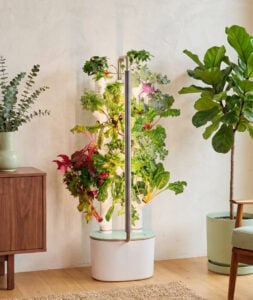
- Indoor garden while on vacation is no longer a tradeoff. A Gardyn with Vacation Mode handles trips up to about two weeks without intervention.
- Under-watering, well-meaning friends overwatering, and disrupted light schedules are the three things that kill indoor plants while owners travel.
- Hardy greens (kale, chard, mature lettuce) hold up best to longer absences. Basil and microgreens are better restarted after a trip than left for two weeks.
- A four-step pre-departure routine handles everything you need to do before a trip: harvest, refill, set Vacation Mode, enable alerts.
- Kelby (the AI assistant) monitors your plants while you’re gone and sends alerts to your phone if anything needs attention.
The summer travel dilemma every plant person faces
Summer is travel season. It is also the peak growing season. The two collide in a frustrating way: the months when an indoor garden is most productive are the same months you are most likely to be out of town for a week or more.
Most indoor plant owners settle the conflict by asking a neighbor or friend to come water. This works about half the time. The other half, the plants get overwatered, underwatered, or forgotten entirely. The well-meaning friend is not a botanist. They do not know how much water is too much. They check on the plants once, panic, and dump in a quart.
Or the owner simply gives up and lets the plants die during the trip, planning to restart in the fall. This is the silent reason a lot of people abandon indoor growing after one summer.
What actually kills indoor plants when you’re away
Under-watering
The obvious one. Most pot-based indoor plants need water every two to four days. A week-long trip can be enough to dry out a small container completely, and most plants do not recover fully from a hard wilt.
Overwatering by a panicked friend
Less obvious but more common. A friend stops by, sees the plants, decides they look thirsty, and waters them all heavily. Then they come back three days later and water again. Roots that sit in saturated soil for a week start to rot. The plant looks fine when you get home, declines a week later, and dies a week after that.
Disrupted light schedules
This one is invisible. Plants on windowsills depend on the sun, which is fine. Plants under indoor grow lights depend on a consistent on/off schedule. If a friend turns the lights off (“I did not want to leave them on”), the plant’s photoperiod gets disrupted and growth slows for weeks afterward.
 How Vacation Mode™ changes the math
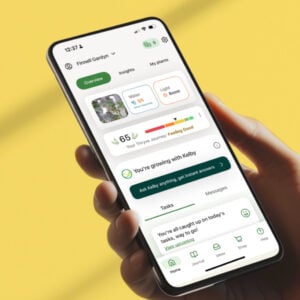
Vacation Mode is a feature, not a marketing phrase. When you enable it through the Gardyn app, three things happen:
First, the system shifts to a longer-interval watering schedule that conserves the reservoir while still keeping the plants healthy. The four-plus-gallon tank in a Gardyn Home holds enough water for one to two weeks of conservative use.
Second, the lighting schedule continues uninterrupted, on the same photoperiod your plants are used to. No human is needed to turn anything on or off.
Third, Kelby (our AI plant care assistant) monitors the system continuously and sends alerts to your phone if the reservoir runs low, a pump issue develops, or any plant shows signs of distress. The cameras inside the column let you check in visually from anywhere.
In practice, a Gardyn owner can leave for a two-week vacation, enable Vacation Mode, and come home to plants that are still producing. We hear this from owners constantly, and it is the single feature that turns the travel objection from a deal-breaker into a non-issue.
| “We left for ten days in July and came back to a column of kale that looked exactly the same as when we left. The basil was a little taller. Nothing died.”
Verified customer review |
The two-week trip checklist
Run this checklist the morning of your departure. It takes about 15 minutes.
1. Harvest everything ready
Pick the leafy greens, herbs, and any ripe tomatoes that are at peak. This serves two purposes: you eat them before they sit unharvested for two weeks, and the plant redirects energy into new growth rather than maintaining mature leaves you will not use.
2. Top off the reservoir
Fill the water tank to the maximum line. Add plant food per your normal schedule. For a Home, this is roughly four-plus gallons. For a Studio, roughly two-plus gallons. Both hold one to two weeks at conservative use.
3. Enable Vacation Mode in the app
Set the start date as your departure and the return date when you will be back. Kelby will adjust the watering interval automatically and notify you if anything changes.
4. Enable Kelby alerts on your phone
Confirm push notifications are on for the Gardyn app. This is your safety net. If something does go wrong (a pump issue, a low water alert), you find out about it immediately rather than coming home to a problem.
Plants that hold up best to longer absences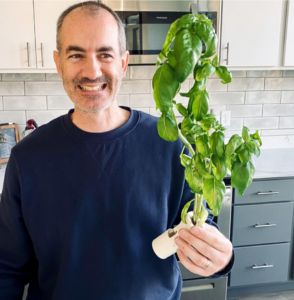
Best for trips of one to two weeks
- Kale: hardy, slow to bolt, mature leaves hold quality
- Chard: similar profile to kale, colorful, forgiving
- Mature lettuce: harvest what is ready before you leave; the rest holds well
- Arugula: bolts faster in summer; better for shorter trips
- Mint: nearly indestructible
Better to restart after the trip
- Basil: high-water-demand and short shelf life; bolts in two weeks
- Microgreens: harvest window is too short to leave unattended
- Cherry tomatoes during heavy fruit set: need regular harvesting to keep producing
| Travel-proof your summer
Memorial Day sale: 20% off Gardyn devices May 15-26, 2026. The only indoor garden built around the way you actually travel in summer. |
What to do when you get home
First, refill the reservoir. The plants are about to enter a heavier growth phase as you start harvesting again.
Second, disable Vacation Mode and resume your normal watering schedule. The plants will catch up within a day.
Third, harvest. Two weeks of growth means a real bumper crop is waiting for you. Plan a salad-heavy first dinner home.
|
Frequently asked questions
How long is the longest trip a Gardyn can handle safely?
Two weeks for most setups is the comfortable upper bound. The water reservoir is the limiting factor. Beyond two weeks, you would need someone to refill once in the middle of the trip. Even three or four weeks is possible with a single check-in.
What if the power goes out while I’m away?
Kelby will detect the system going offline and notify you immediately. Plants in a Hybriponic™ column have enough moisture retention to tolerate a short outage without damage. For longer outages (over 24 hours), having a neighbor or friend with access is useful.
What if my WiFi goes down?
Vacation Mode continues to run locally. The watering, lighting, and care all proceed normally without the cloud connection. You lose the ability to monitor remotely until WiFi is restored, but the plants themselves are safe.
Can a neighbor monitor through the app instead of physically visiting?
Yes. You can grant app access to a family member or trusted neighbor so they can check the cameras and reservoir level without coming over. This is the lowest-friction way to add a human safety layer if you want one.
Do I need to do anything special before leaving in winter vs. summer?
Summer trips usually mean higher water use due to warmer indoor temperatures. Top the reservoir all the way off, and consider closing curtains or blinds in the room to reduce ambient temperature. Winter trips are easier because water use drops with cooler indoor temps.
Will my plants flower or bolt while I’m away in summer?
Some short-season greens (arugula, cilantro) can bolt in two weeks during summer heat. Hardy greens (kale, chard) are bolt-resistant and hold up much better. Your plant selection matters more than the duration of your trip.