Cookies help us deliver the best experience on our website. By clicking Accept you are agreeing to the placement and use of cookies as described in our privacy policy.


Germination is the most delicate stage of any plant’s life, and it’s where most new hydroponic growers run into trouble. Get the media, moisture, temperature, and timing right and you’ll have thriving seedlings. Get it wrong and you’re starting over. This guide covers what you need to know, including an approach that removes the guesswork entirely.
Key takeaways
- Successful seed germination requires the right combination of moisture, temperature, oxygen, and absence of light.

- Rockwool starter cubes and coco coir plugs are the most reliable germination media for hydroponic systems.
- pH of germination water should be maintained between 5.5 and 6.5 for most vegetable and herb seeds.
- Most herb and vegetable seeds germinate within 3–7 days under ideal conditions.
- Pre-seeded yCubes from Gardyn handle germination automatically : no media, no pH management, no guesswork.
Why seed starting in hydroponics is different
In soil, germination media does double duty: it holds moisture, provides physical support, and buffers against extreme conditions. The soil ecosystem is complex enough to compensate for minor inconsistencies in watering, temperature, or timing.
In hydroponics, you’re creating that environment from scratch in a controlled, inert medium. There’s no buffering complexity to bail you out, which means precision matters more, but also means results are more consistent once you’ve got the conditions right.
Germination media options
Rockwool starter cubes
Rockwool is the industry standard for hydroponic seed starting. Made from spun volcanic rock, it holds moisture well, provides excellent aeration, and is pH-neutral (though you should pre-soak in pH 5.5 water before use). Seeds sit in a small hole in the top of the cube, held in close contact with moist medium.
Rockwool is effective and widely available, but it’s not reusable and requires careful handling : the fibers can be irritating to skin and lungs. Use gloves and avoid tearing or breaking cubes.
Coco coir plugs
Compressed coco coir (coconut fiber) plugs are a popular organic alternative to rockwool. They expand when wetted, provide good moisture retention, and are biodegradable. Coco coir has a natural pH tendency toward 5.5–6.0, making it naturally suitable for most hydroponic crops.
Jiffy pellets and starter foam
Jiffy pellets (compressed peat or coco) and proprietary starter foam products work well for seed starting and are easy to handle. Like coco plugs, they require pre-soaking before use.
Step-by-step: starting seeds hydroponically
Step 1: Pre-soak your germination media in pH-adjusted water (5.5–6.0). For rockwool, soak for 30–60 minutes, then allow to drain until media feels moist but not saturated, you should be able to squeeze a few drops of water from it, but it shouldn’t drip freely.
Step 2: Place 1–2 seeds per cube or plug. Larger seeds can be pushed 3–5mm below the surface; fine seeds like lettuce and basil sit on the surface or just barely covered. Don’t over-seed, crowded seedlings compete and are harder to thin.
Step 3: Cover your seeded cubes with a humidity dome or plastic wrap. Germinating seeds need high humidity (80–90%) and darkness. Most seeds don’t need light until after the cotyledon (seed leaf) emerges.
Step 4: Maintain temperature between 68–77°F (20–25°C). Most vegetable and herb seeds germinate best in this range. A seedling heat mat can help if your space is cool.
Step 5: Check moisture daily. Media should stay consistently moist : not wet. Mist with pH-adjusted water if the surface starts to dry. Avoid saturating media, which can cause damping-off (fungal rot at the seedling base).
Step 6: Once seedlings emerge and show their first true leaves (not just the seed leaves), remove the humidity dome and move under grow lights. Keep lights close, 2–4 inches for most seedlings, to prevent leggy, stretched growth.
Common seed starting problems and solutions
| Problem | Likely cause | Fix |
| No germination after 10+ days | Too cold, too dry, or old seeds | Check temperature and moisture; replace seeds if old |
| Leggy, stretched seedlings | Not enough light | Move lights closer; ensure 16–18 hrs light after emergence |
| Damping off (stem rot at base) | Overwatering or poor air circulation | Reduce moisture; improve ventilation around seedlings |
| Yellowing seedlings | Nutrient deficiency or pH issue | Check pH; introduce dilute nutrient solution after first true leaves |
| Seeds germinate then stall | Transition shock from germination to hydro system | Ensure pH match and gentle introduction to nutrient solution |
The easier approach: pre-seeded yCubes
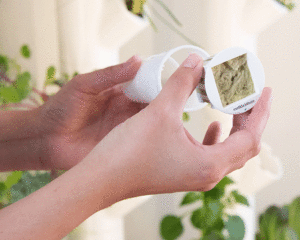
Everything described above is manageable, but it’s also several days of careful monitoring before you even have a seedling. Gardyn yCubes arepre-seeded at the optimal depth in a proprietary growing medium, calibrated for Gardyn’s Hybriponic™ environment. You insert them into the system, add water, and Kelby handles germination conditions automatically.
The result: consistent germination rates without humidity domes, pH meters, or heat mats. For busy households, this is a significant practical advantage.
Want to use your own seeds? Seedless yCubes give you the same pre-formed growing medium in Gardyn’s format, add your own seeds and drop them into the system.
|
For more on the science of germination, see our in-depth blog post: from seed to sprout : the science behind germination.
|
|
Frequently asked questions
How long does it take for hydroponic seeds to germinate?
Most herbs and greens germinate within 3–7 days under optimal conditions (65–75°F, high humidity, proper moisture). Slower germinators like parsley and celery may take 10–14 days. Tomatoes and peppers typically germinate in 5–10 days.
Do seeds need nutrients to germinate?
No, seeds contain enough stored energy to germinate and produce their first seed leaves. Nutrients become important after the first true leaves appear. Starting with plain pH-adjusted water (no nutrient solution) is best practice for germination.
Can I germinate seeds directly in my hydroponic system?
Some growers do this successfully, but it’s generally better to germinate in dedicated media first. Direct system germination can expose seeds to nutrient concentrations that inhibit germination, and wet-dry cycling from system pumps can disrupt the consistent moisture seeds need.
What’s the ideal temperature for hydroponic seed germination?
68–77°F (20–25°C) is the optimal range for most vegetable and herb seeds. At temperatures below 60°F, germination slows significantly or fails. At temperatures above 85°F, some cool-season crops like lettuce will fail to germinate entirely.