Cookies help us deliver the best experience on our website. By clicking Accept you are agreeing to the placement and use of cookies as described in our privacy policy.


Summer is supposedly the salad season. In practice, it is the season your bagged greens turn to slime three days after you buy them, the season your refrigerator drawer becomes a graveyard of half-used herbs, and the season you give up and order takeout because the produce you paid for has already failed you.
There is a better way, and it has nothing to do with discipline or meal planning. It has to do with proximity. When greens are growing in your living room and you walk over and pick them seconds before you eat, the equation changes. The salad gets fresher, the nutrient profile gets better, and the friction disappears.
This is the case for homegrown summer salads, the indoor greens worth growing, and a few simple templates that turn a daily pick into a real meal.
Key takeaways
- Homegrown summer salads stay nutrient-dense because greens lose vitamin C and folate within days of harvest, and most grocery greens are already 7 to 14 days old when you buy them.
- Five greens carry summer eating beautifully indoors: butterhead lettuce, arugula, kale, basil, and a heat-tolerant pick like chard or sorrel.
- Two simple templates (greens + tomato + herb, or greens + fruit + nut + cheese) cover most of the season without recipe hunting.
- An indoor garden takes the routine off you. A Gardyn handles the watering, lighting, and care while you handle the picking and the eating.
- Continuous harvest means the salad never ends. One column produces fresh greens every day, every week, every month, with no replanting needed.
Why summer salad season is harder than it looks
The math on grocery greens is unflattering. Research published in the Journal of Agricultural and Food Chemistry has shown that leafy greens can lose more than half their vitamin C within a week of harvest, even under cold storage. Spinach stored at typical retail temperatures loses about 47 percent of its folate in eight days. By the time a bag of greens reaches your refrigerator, the clock has been running for one to two weeks already.
Then summer heat hits. Warm transit, the trip from store to car, the wait until you actually eat them, and the gradual wilt all compound the loss. The same salad that promised “crisp” on the packaging hits the bowl limp, and the nutritional density on the label is more aspiration than fact.
The fix is not to eat better grocery greens. It is to remove the supply chain from the equation entirely.
What “fresh” actually means for nutrient retention
The vitamins that disappear first
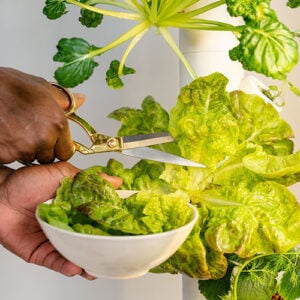 Vitamin C and folate are the most fragile nutrients in leafy greens. They are water-soluble, sensitive to light, and degrade through normal cellular respiration after the plant is cut. A spinach leaf at harvest may contain 28 mg of vitamin C per 100 g. A week later, depending on storage, that number can fall by 30 to 50 percent. For folate, the picture is similar.
What stays stable
Fiber, minerals like iron and magnesium, and most of the carotenoids (the pigments that make greens green and dark) are more stable. So a week-old bag of spinach still delivers fiber and iron. What it loses is the bright, water-soluble vitamin layer that gets headline space on nutrition labels.
Why this matters for summer eating
Summer is the season your body actually needs those water-soluble vitamins. Sweat increases turnover. Higher fluid intake means more flushing. The cooked-down winter meals get replaced by raw vegetables where freshness shows immediately on the plate. Eating greens picked the same day is the simplest possible upgrade to your summer nutrition, and it does not require any new habit beyond walking across the room.
The summer salad greens that work best indoors
Not every leafy green earns a spot in a small indoor garden. The five below cover the texture, flavor, and nutrition range you need for an entire summer of varied salads, and all five thrive in a Hybriponic™ system.
Butterhead lettuce
Soft, sweet, and quick. Butterhead lettuce gives you the tender base for salads that hold a vinaigrette without bruising. It tolerates indoor temperatures better than romaine in summer and is ready to start harvesting in about three to four weeks.
Arugula
Arugula is the peppery counterweight to butter lettuce. Cut-and-come-again means you pick the outer leaves and the plant keeps producing. Excellent with strawberries, peaches, and any sharp cheese, which makes it the workhorse green of summer eating.
Kale
Kale gets a lot of wellness press for good reason. It is one of the most nutrient-dense leafy greens in the catalog, and it grows reliably indoors. Massaged kale salads are a summer staple because the leaves soften but do not wilt the way lettuce does. Indoor kale also handles the warmer weeks of summer without bolting.
Basil
Technically an herb, basil belongs in this list. A few torn leaves transform a tomato-and-mozzarella plate into a meal. Fresh basil from your own garden tastes nothing like the wilted clamshell version, because basil’s volatile aromatic compounds dissipate within hours of picking. This is the green most worth growing yourself.
A heat-tolerant fifth pick
Round out the column with something that holds up under summer indoor temperatures. Chard, sorrel, or New Zealand spinach all qualify. Chard adds color and a mineral-rich bite. Sorrel brings a lemony note that makes vinaigrettes optional.
| “The single biggest lever for nutrient density in your salad is how recently you picked it. Everything else is downstream of that.”
Lindsay Springer, Ph.D., Director of Plants, Nutrition & Digital Agriculture, Gardyn |
Two simple summer salad templates
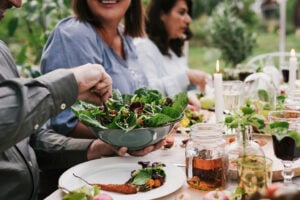
The reason most people stop eating salads in summer is not boredom. It is decision fatigue. The templates below remove the deciding.
Template 1: Greens + tomato + herb + olive oil + lemon
This is the Mediterranean default. A handful of mixed greens, ripe tomato, torn basil or mint, good olive oil, lemon, flaky salt. The herb does the work. Picked-that-minute basil with picked-that-minute tomato is the entire dish, and it will outclass anything you assemble from grocery components.
Template 2: Greens + soft fruit + nut + cheese + acid
The summer fruit template. Arugula, peach or strawberry, toasted almonds or pistachios, soft cheese (goat, feta, or burrata), balsamic or sherry vinegar. This works through July and August because soft fruits and sharp greens are the same season.
How to make either template a meal
Add a protein and a starch and you have dinner. Grilled chicken, canned chickpeas, white beans, soft-boiled eggs, or grilled halloumi over the salad. Toasted bread or a cup of farro alongside. The point of the template is that the greens are the foundation. Once the greens are taken care of, everything else slots in.
How a Gardyn fits the summer salad routine
The honest sell on an indoor garden for summer eating is the routine, not the gadget. A Gardyn Studio or Gardyn Home is a floor-standing column that grows up to 30 plants in about two square feet. It uses our proprietary Hybriponic™ system, which combines hydroponic water delivery with the moisture and oxygen plants need at the root, and our AI assistant Kelby handles the daily watering and lighting decisions.
What this means in practice: you fill the reservoir every week or two, pop in the yCubes (compostable plant pods pre-seeded with the plants you want to grow), and walk over to the column to pick when you want salad. The routine is the harvest. Nothing else.
For a salad-focused setup, four yCubes carry the column through summer: butterhead lettuce, arugula, kale, and basil. A fifth slot is open for whatever you are excited to try (a cherry tomato yCube turns the whole column into a hosting workhorse).
The cost math on homegrown summer salads
A bag of organic spring mix runs four to six dollars and lasts three to five days. A family eating salads three or four times a week spends $50 to $80 a month on greens alone in summer, and a meaningful percentage gets thrown out before it can be eaten.
A Gardyn column producing continuously hands you fresh greens at well under a dollar per harvest after the device is paid down. The deeper savings come from the meals you actually eat instead of the takeout you order when the grocery greens have failed you again.
| Start your summer salad season
A Gardyn floor column grows up to 30 plants in two square feet. Pick fresh greens, herbs, and tomatoes seconds before they hit the plate. Memorial Day sale is on now. |
Frequently asked questions
How often can I harvest salad greens from a Gardyn?
After the first three to four weeks of growth, most leafy greens (lettuce, arugula, kale) support continuous harvest. Pick the outer leaves and the plant keeps producing for two to three months from a single yCube.
Do I need a window or direct sunlight?
No. A Gardyn uses full-spectrum LED grow lights that replicate sunlight, so it works in any room (basement, hallway, windowless apartment). It does need a standard power outlet within reach.
What happens to my plants when I travel?
Vacation Mode keeps your plants cared for while you are away. The reservoir holds enough water for one to two weeks, the lighting schedule continues automatically, and Kelby sends alerts to your phone if anything needs attention.
How does the cost compare to buying organic greens at the grocery store?
Most growers report the device pays for itself within the first year of regular use. A bag of organic mixed greens runs $4 to $6 and lasts a few days. A continuously producing column delivers comparable greens at a fraction of the cost.
Can kids help with the harvesting?
Yes, and they tend to eat more greens when they do. The picking is the easy and rewarding part. Kelby handles the technical care, so kids interact with the fun parts (choosing plants, picking dinner) without the parts that can fail.
Are homegrown indoor greens really more nutritious than grocery greens?
For water-soluble nutrients like vitamin C and folate, yes, measurably. The losses in leafy greens happen quickly after harvest, and grocery greens are typically one to two weeks old by the time you eat them. Same-day-pick greens preserve far more of these vitamins.