Cookies help us deliver the best experience on our website. By clicking Accept you are agreeing to the placement and use of cookies as described in our privacy policy.


Working from home means eating from home. For anyone doing 3, 4, or 5 days a week remote or hybrid, weekday lunch has become the daily kitchen problem. Grocery runs are exhausting to fit around meetings. Delivery adds up fast. Leftovers get monotonous. And the standard WFH lunch (a mediocre sandwich, a bowl of leftover pasta, whatever’s in the fridge) is missing exactly one thing that would fix it: something fresh.
A home office garden solves that. A Gardyn Studio column tucked into a corner produces a continuous supply of herbs, salad greens, and cherry tomatoes, all reachable from your desk in under a minute. Here’s what to grow and what to make.
Key takeaways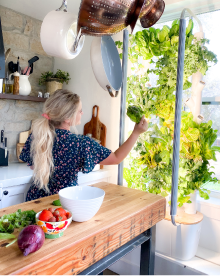
- Remote and hybrid workers eat 200 to 400 more meals at home per year than pre-pandemic office workers. Fresh ingredients for those meals is the single biggest quality-of-life upgrade.
- A Gardyn Studio column fits in about 4 square feet of floor space and produces continuous herbs, salad greens, cherry tomatoes, and edible flowers, all reachable from your desk.
- The core WFH loadout: basil, cilantro, mint, arugula, butter lettuce, and cherry tomatoes. Six yCubes covers 90 percent of weekday lunches.
- Peak-fresh ingredients dramatically reduce reliance on delivery. Even a great sandwich made with same-day-picked basil and cherry tomatoes beats most delivery lunches at 15 to 20 dollars a hit.
- The garden also serves as a small mental break during the workday: a 90-second walk to harvest ingredients is a real reset.
Why WFH lunches are structurally different
The WFH lunch is not the same problem as the office lunch. Office lunches are social, out-of-the-house, often eaten with colleagues, and often paid for. WFH lunches are solitary, at the kitchen table (or desk), self-prepared, and paid for by you.
This changes the daily calculus. If lunch is going to be self-prepared, the ingredients matter enormously. A great sandwich or a real salad is 15 minutes of work if the ingredients are on hand and 45 minutes if they require a grocery run. The single biggest lever for a good WFH lunch is having the fresh components already in the kitchen when the meeting ends.
The 6-yCube WFH loadout
- Basil (universal ingredient)
Basil is the highest-utility WFH herb. It goes on sandwiches (tomato-mozzarella, chicken pesto), in pastas (quick pesto, cherry tomato and basil), in salads (caprese, tomato salad), and in dressings. Continuous production means you’re never rationing basil for a special dinner; it’s always available.
- Cilantro (bright weekday flavor)
Cilantro transforms weekday leftovers. A pinch on a rice bowl, on scrambled eggs, in a wrap, on top of yesterday’s soup. Small quantities, high impact. Grocery cilantro turns yellow in the fridge within days; garden cilantro is always fresh.
- Mint (unexpected everyday herb)
Mint isn’t just for cocktails. Chopped mint on a fruit salad, in a yogurt bowl, on a Middle Eastern-style rice, or in an iced water pitcher gets used more than most WFH gardeners expect. Also excellent in a work-from-home 3 PM tea break.
- Arugula (salad and sandwich base)
Arugula is the WFH salad green. Peppery, robust, holds well on a sandwich, and pairs with almost any dressing. Two handfuls plus cherry tomatoes plus cheese plus olive oil is a real salad in 3 minutes.
- Butter lettuce (wraps and light salads)
Butter lettuce provides the softer green counterpoint to arugula. Perfect for lettuce cups (chicken salad, tuna salad, ground turkey), for lighter salads, and for sandwich layers when arugula is too peppery.
- Cherry tomatoes (garnish and salad)
Cherry tomatoes are the fresh flavor engine of most WFH salads and lunches. A handful halved on top of pasta, on a sandwich, in a salad, or blistered in a pan for 3 minutes as a warm side. The continuous supply is what makes a Gardyn column different from a windowsill herb pot.
The 5 WFH lunches this garden produces
- The 3-minute garden salad
2 cups arugula, 1 cup halved cherry tomatoes, 2 tablespoons olive oil, 1 tablespoon vinegar, salt, pepper. Whatever protein is in the fridge (leftover chicken, canned tuna, chickpeas). Done.
- The pesto pasta
Blend 2 cups fresh basil with 1/4 cup olive oil, 2 garlic cloves, 1/4 cup Parmesan, and a handful of walnuts. Toss with hot pasta and a splash of pasta water. 12 minutes total.
- The Vietnamese-style noodle bowl
Rice noodles, protein of choice (rotisserie chicken or leftover pork), fresh cilantro, mint, cherry tomatoes, chili, lime, fish sauce. Everything fresh from the garden except the noodles and protein. 8 minutes.
- The butter lettuce wraps
Ground chicken or turkey, sautéed with soy, ginger, garlic. Spoon into butter lettuce leaves. Top with cilantro, mint, chopped peanuts. Weekday dinner in 15 minutes.
- The tomato-basil sandwich
Toasted sourdough, mayo, sliced cherry tomatoes, torn basil, flaky salt. 4 minutes. Better than most delivery lunches.
“Working from home means eating from home. A home office garden turns that into an advantage instead of a chore. Fresh herbs and cherry tomatoes at your desk beat delivery on every dimension: cost, quality, and control.” Gardyn editorial
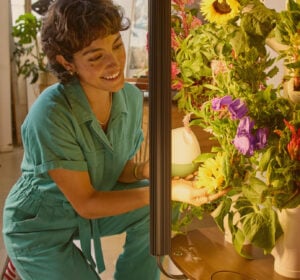 The garden as a workday break
The 90 seconds it takes to walk to the garden, cut a fistful of basil and a handful of cherry tomatoes, and walk back is a real cognitive break. It’s not the same as a real walk outside, but it’s a movement break, a sensory break (color, smell, texture), and a task-switching moment. For WFH workers who otherwise sit for 8-hour stretches, small moments like this add up.
Multiple studies on office design have found that indoor plants improve mood, focus, and creative task performance. A Gardyn column is a much larger plant investment than a single desk plant. The effect is proportionally larger.
The cost math
For a hybrid worker doing 3 to 4 WFH days per week, weekday lunch costs typically run:
- Delivery: 15 to 25 dollars per meal, 45 to 100 dollars per week
- Grocery-based homemade: 5 to 10 dollars per meal, 15 to 40 dollars per week
- Garden-supplemented homemade: 3 to 7 dollars per meal, 10 to 30 dollars per week
The garden itself amortizes over a year. Fresh basil that would cost 3 dollars a bunch at the grocery is now unlimited. The mental math changes from ‘is it worth making a real salad today?’ to ‘the salad ingredients are literally 8 feet away.’
Placement in the home office
The Gardyn Studio is designed for smaller footprints (about 4 square feet). Good placement options:
- Corner of the home office next to the desk
- End of the kitchen counter closest to the home office
- Along a wall in an open-plan living area, visible from both the kitchen and the workspace
The full Gardyn Home column has a larger footprint but produces roughly twice the volume. For households where multiple people work from home, the Home is often worth the additional space.
The Gardyn WFH loadout
A Gardyn Studio column with basil, cilantro, mint, arugula, butter lettuce, and cherry tomatoes covers 90 percent of weekday WFH lunches. Add oregano, dill, or thyme for variety. Add strawberries in a lower slot for a mid-afternoon snack. The garden becomes part of the workday rhythm.
| Upgrade your WFH lunches
A Gardyn Studio column fits in the corner of a home office and produces continuous fresh herbs, greens, and cherry tomatoes for weekday meals. |
Frequently asked questions
Do I need a full Gardyn Home or is a Studio enough?
For one WFH worker, a Studio is enough. It produces about 16 plants continuously, which covers 90 percent of weekday lunches. For a household with two or more WFH workers, or for anyone who cooks dinner from the garden as well, a Gardyn Home is worth the additional space.
How much time does the garden actually save?
Not much on any given day, but the compound effect over a year is significant. The garden eliminates herb-and-salad-green grocery runs, which are the most fragile part of a fresh-food kitchen. That eliminates the classic WFH problem of running out of the fresh ingredient that would have made lunch great.
Does the garden distract me during Zoom calls?
If the column is in the video-call background, it looks great on camera. Actually watching the plants grow is not a distraction risk; herbs and greens grow slowly enough that daily change is minimal. The 90-second lunch harvest is a break, not a distraction.
What if I travel for work and skip WFH days?
The garden continues producing while you’re away. Vacation Mode is designed for this: it slows watering and reduces light exposure so plants hold longer without harvest. When you return, resume normal operation.
Can I run the garden year-round?
Yes. Gardyn columns are indoor units and produce continuously through winter, when outdoor gardens can’t. Fall and winter are actually when a WFH garden delivers the most value; cold months are when delivery is most tempting and grocery runs are least fun.
What’s the noise level? I take video calls near the garden.
The Gardyn pump runs at low volume (about 45 dB at 3 feet, quieter than a refrigerator). Most owners report the noise is not audible on video calls. The pump also runs primarily overnight when the calls aren’t happening.
How long from planting to first useful harvest?
Basil, arugula, and butter lettuce are ready for first harvest at 4 to 5 weeks. Cherry tomatoes fruit at week 8 to 10. Herbs at full production by week 6. Plan on 6 weeks from setup to a really productive kitchen.