Cookies help us deliver the best experience on our website. By clicking Accept you are agreeing to the placement and use of cookies as described in our privacy policy.


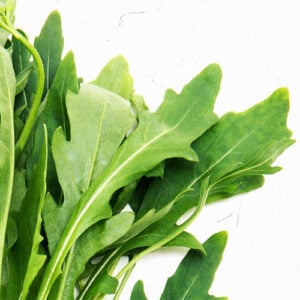
The peppery bite of arugula is not just a flavour characteristic. It is the sensory signal of glucosinolate content, the sulfur-containing plant compounds that convert to isothiocyanates during digestion and produce some of the most well-studied health effects in dietary plant science. Arugula’s flavour intensity is a direct proxy for its phytochemical potency.
Key takeaways
- Arugula contains ~480mg of dietary nitrate per 100g, one of the highest among commonly consumed salad vegetables, which converts to nitric
 oxide and improves blood flow and exercise efficiency.
 - The glucosinolates glucoerucin and erucin in arugula convert to erucin isothiocyanate, which has demonstrated anti-cancer, anti-inflammatory, and liver detoxification effects in multiple studies.
- More intense pepper flavour = higher glucosinolate content. Home-grown arugula harvested at peak peppery stage delivers more phytochemicals than store-bought arugula selected for mild flavour.
- The myrosinase enzyme that activates glucosinolates is destroyed above ~70°C, eating arugula raw and chewing thoroughly is critical for full conversion to active isothiocyanates.
- Arugula provides ~109mcg of vitamin K1 per 100g (~90% of the adequate daily intake) alongside ~160mg of calcium per 100g with low oxalates, making its calcium among the most bioavailable of any leafy green.
- A 2016 review in Nitric Oxide confirmed that dietary nitrate from vegetables improved endothelial function and insulin sensitivity across multiple clinical studies.
Glucosinolates: the peppery health compound
What glucosinolates are and how they activate
Glucosinolates are sulfur-containing secondary metabolites produced by plants in the Brassicaceae family. When the plant is chewed or chopped, the enzyme myrosinase converts glucosinolates into biologically active isothiocyanates. Arugula contains glucoerucin, erucin, and gluconasturtiin as its primary glucosinolates, producing a distinct isothiocyanate profile studied for anti-cancer, anti-inflammatory, and liver detoxification effects.
The peppery flavour signal
More intense pepper flavour generally indicates higher glucosinolate content. Home-grown arugula, harvested at the right stage of maturity, can be more flavourful and more phytochemically potent than grocery store arugula that has been selected for mild flavour and stored for days. The commercial selection process that makes arugula more palatable to mainstream consumers simultaneously reduces its most distinctive health compounds.
Dietary nitrates: cardiovascular and exercise effects
What dietary nitrates do
Dietary nitrates from vegetables are converted to nitric oxide (NO) in the body via a pathway involving oral bacteria and stomach acid. Nitric oxide is a vasodilator: it relaxes smooth muscle in blood vessel walls, reducing blood pressure and improving blood flow. A 2016 review in the British Journal of Clinical Pharmacology confirmed that dietary nitrate from vegetables, including arugula, improved endothelial function and insulin sensitivity across multiple clinical studies.
Exercise performance
A meta-analysis in the Journal of the International Society of Sports Nutrition found that dietary nitrate from whole vegetables significantly improved exercise efficiency and time-to-exhaustion. Arugula’s nitrate content of approximately 480mg per 100g makes a large pre-exercise salad (60 to 90 minutes before activity) a meaningful performance-supporting meal.
Plants for athletes for a broader view of food timing and athletic performance.
Bone health: vitamin K and calcium
 Vitamin K1 content
Arugula provides approximately 109 micrograms of vitamin K1 per 100g, around 90 percent of the adequate intake for adults. Vitamin K1 is required for the carboxylation of osteocalcin, a bone matrix protein that incorporates calcium into bone structure. Without adequate vitamin K, osteocalcin cannot function properly and absorbed calcium is less effectively incorporated into bone.
Calcium with low oxalates
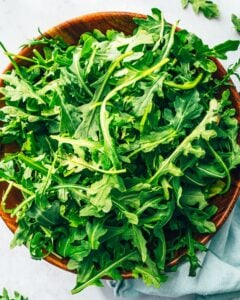
Arugula provides approximately 160mg of calcium per 100g, meaningfully higher than spinach per gram. Unlike spinach, arugula has low oxalate content, meaning its calcium is absorbed more efficiently. Studies estimating absorbable calcium from different vegetables find arugula and other low-oxalate brassicas more efficient calcium sources per gram than high-oxalate vegetables like spinach and chard.
Why home-grown arugula is different
Store-bought arugula is typically harvested before peak glucosinolate development to maximise shelf life and produce a milder flavour. Home-grown arugula, harvested at the stage that produces maximum peppery bite, delivers higher glucosinolate content. Growing arugula in the Gardyn system and harvesting at peak peppery flavour captures maximum phytochemical content.
Grow arugula at home. For recipe inspiration, see arugula salad recipes.
Frequently asked questions
Is arugula better than spinach nutritionally?
They have different strengths. Arugula is higher in nitrates, has lower oxalate content (better mineral bioavailability), and contains glucosinolates. Spinach is higher in iron, folate, and magnesium. Eating both provides complementary nutritional profiles.
How much arugula do I need to get meaningful nitrate effects?
Research on dietary nitrate effects typically uses 300 to 500mg of nitrate, equivalent to approximately 60 to 100g of arugula (a moderate salad portion). A large arugula salad provides a meaningful contribution at culinary doses.
Does baby arugula have the same nutritional profile as mature arugula?
Baby arugula is harvested earlier and is milder in flavour, which generally indicates lower glucosinolate content. For maximum nutrition, allowing arugula to develop its characteristic peppery flavour before harvesting is preferable.