Cookies help us deliver the best experience on our website. By clicking Accept you are agreeing to the placement and use of cookies as described in our privacy policy.


Amaranth occupies an unusual nutritional position: it is one of the few plants that provides a complete protein profile, meaning it contains all nine essential amino acids in proportions that meet human requirements. This distinction is most commonly discussed in the context of amaranth grain, but the leafy form of the plant, the fresh greens that can be grown and harvested continuously in a Gardyn system, shares much of this nutritional profile alongside its own distinctive vitamin and mineral content.
Key takeaways
- Amaranth is one of the few plant foods that provides all nine essential amino acids in a complete profile, a distinction it shares with quinoa and
 soy but that is rare among leafy greens.
 - Amaranth leaves provide ~215mg of calcium per 100g, higher than spinach (99mg), kale (150mg), and most commonly grown leafy greens, with relatively lower oxalate content than spinach.
- Amaranth leaves provide ~2.3mg of iron per 100g alongside ~43mg of vitamin C, which enhances absorption from the same plant. The vitamin C and iron are naturally co-located.
- Red amaranth varieties contain betalain pigments, the same antioxidant compounds found in beets and purslane, with demonstrated anti-inflammatory and antioxidant activity in cell studies.
- Amaranth can be used as a direct spinach substitute in virtually any preparation: wilted in olive oil, blended into smoothies, added to soups, or eaten raw when young and tender.
- Young amaranth leaves harvested at two to four weeks are most tender and suitable for raw consumption, continuous harvest of young leaves encourages the plant to keep producing.
The protein content: what complete protein means
Essential amino acids
Proteins are built from 20 amino acids, nine of which the human body cannot synthesise and must obtain from food: histidine, isoleucine, leucine, lysine, methionine, phenylalanine, threonine, tryptophan, and valine. A complete protein source provides all nine in sufficient amounts relative to human requirements.
Why this is unusual for plant foods
Most plant proteins are limited in one or more essential amino acids: legumes are typically low in methionine, grains are typically low in lysine, and most vegetables have insufficient protein overall. Amaranth, like quinoa and soy, is a rare plant exception that provides all nine essential amino acids. Research comparing amaranth protein quality to animal sources has confirmed its favourable amino acid profile, with particular strength in lysine, an amino acid often limiting in grain-based diets.
The broader nutritional profile of amaranth leaves
Iron and vitamin C: co-located for maximum absorption
Amaranth leaves are notably high in iron, approximately 2.3mg per 100g, alongside approximately 43mg of vitamin C per 100g. The natural co-location of iron and its primary absorption enhancer in the same plant is nutritionally efficient. Unlike spinach, amaranth has relatively lower oxalate content, improving iron bioavailability.
 Calcium: higher than most leafy greens
Fresh amaranth leaves provide approximately 215mg of calcium per 100g, higher than spinach (99mg), kale (150mg), and most commonly grown leafy greens. Combined with their lower oxalate content relative to spinach, amaranth greens represent one of the more bioavailable plant-based calcium sources among leafy vegetables.
Betalains and carotenoids
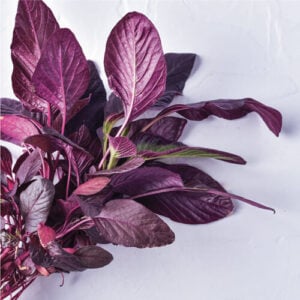
The striking red-purple colour of red amaranth varieties comes from betalain pigments, the same class of antioxidant compounds found in beets and purslane. Green amaranth varieties contain carotenoids including beta-carotene and lutein.
The July plant release featuring Red Amaranth provides details on this variety.
How to use amaranth greens
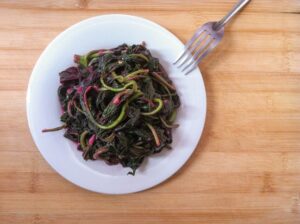
- As a spinach substitute in virtually any application, wilted in olive oil and garlic, blended into smoothies, added to soups, or eaten raw in salads when young and tender
- In West African stews (callaloo), South Asian palak-style preparations, and Chinese stir-fries, traditional preparations that work well with Gardyn-grown varieties
- Raw when young: leaves harvested at two to three weeks are tender enough to eat raw in salads, harvesting at this stage maximises tenderness and nutritional content
Frequently asked questions
Is amaranth grain different from amaranth greens?
Yes. Amaranth grain (the seed) is what most protein-focused amaranth research addresses. Amaranth greens are the fresh leaves of the same plant. Both share the complete protein profile, but the grain is more calorie and protein dense per gram. The greens provide a complementary nutritional profile as a fresh vegetable.
Can I grow amaranth indoors year-round?
Yes. Amaranth grows well in the Gardyn Hybriponic system with consistent light and nutrients. It does not require seasonal outdoor conditions and produces continuous harvests from a single planting.
What is the best stage to harvest amaranth greens?
Young leaves at two to four weeks from germination are most tender and suitable for raw consumption. Older leaves develop more texture and are best lightly cooked. Continuous harvest of young leaves encourages the plant to keep producing.